Luxury cruising today is less about ostentation and more about orchestration—the precise choreography of comfort, privacy, and intuitive service at scale. For the discerning traveler, the true allure lies not only in the headline suites and caviar-laden brunches, but in the quieter, almost concealed layers of thoughtfulness that separate a merely expensive voyage from a genuinely elevated one.
Below, we explore five exclusive, often-overlooked dimensions of luxury cruises that seasoned enthusiasts quietly seek out—and that can transform a well-appointed sailing into a deeply memorable one.
The Architecture of Stillness: Seeking the Quietest Luxuries Onboard
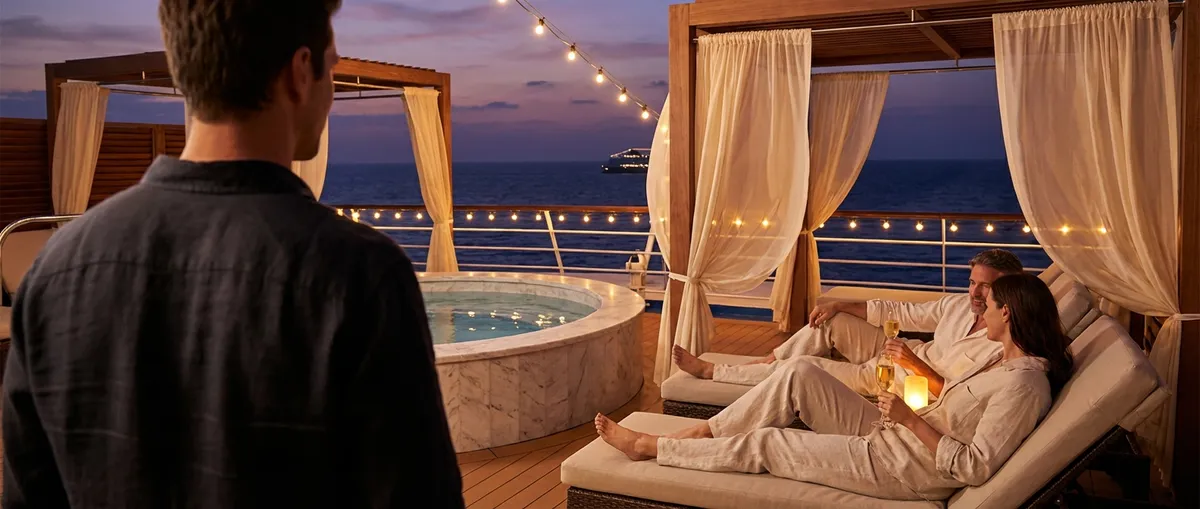
On a modern luxury ship, silence is a curated resource. While brochures highlight spas and infinity pools, experienced travelers pay close attention to how a ship physically manages noise, privacy, and flow. On ultra-luxury and premium lines, design teams increasingly use sound-dampening materials, cleverly angled corridors, and “buffer” spaces—library lounges, art galleries, and low-traffic stairwells—to create pockets of calm even when occupancy is high.
The most sophisticated guests often work with cruise concierges or travel advisors to map out “quiet zones” before embarkation—selecting suites away from service elevators, theater bulkheads, or late-night venues, and favoring deck plans where passenger staterooms sit above and below for acoustic insulation. Some ships now incorporate dedicated “tranquility areas” with limited capacity and stricter noise expectations, accessible only to suite guests or through pre-booked passes.
The result is an onboard experience where serenity does not depend on luck or timing; it is designed. For many luxury cruisers, that reliable stillness—a balcony where you hear only the sea, a lounge where the loudest sound is a cocktail being stirred—is a greater indulgence than any bottle in the cellar.
Invisible Service: When Anticipation Replaces Intervention
At the highest tier of cruising, service as spectacle is quietly giving way to service as invisibility. The most coveted experiences often involve staff who appear only when needed, leave no trace of interruption, and seem to anticipate preferences guests have not yet articulated. This is not coincidence but the sophisticated application of training, guest profiling (with consent), and data.
Luxury lines now invest heavily in staff education not just in etiquette, but in micro-observation: noting how a guest organizes their in-suite workspace, whether they linger over certain wines, or how often they request in-room dining versus specialty restaurants. Some ships use secure preference-tracking systems that carry forward from voyage to voyage, allowing returning guests to find their favorite non-alcoholic champagne already chilled, or feather pillows already installed without a word.
The most rarefied service feels almost telepathic: a butler arriving with a garment steamer minutes after luggage is delivered; a sommelier adjusting wine pairings mid-meal when they realize you favor Old World restraint over New World exuberance. To insiders, this frictionless anticipation—rather than formalities or flourishes—is the new gold standard.
Curated Off-Ship Moments: Beyond Group Excursions and Mass-Market Tours
The true luxury cruiser understands that a ship’s refinement is only half the equation; the measure of a voyage often lies in what happens just beyond the gangway. Public excursions, even on high-end lines, can skew toward the predictable and crowded. The connoisseur looks for itineraries and services that enable private, unscripted, or hyper-tailored experiences ashore.
On some luxury lines, dedicated destination concierges act less like tour operators and more like cultural fixers—quietly securing after-hours access to museums, coordinating private tastings with winemakers, or arranging one-on-one time with local chefs, historians, or artisans. In certain ports, guests can discretely book yacht tenders or chauffeured cars that avoid cruise-terminal congestion entirely, slipping them into the city via lesser-known marinas or hotel entrances.
For the enthusiast, this fusion of shipboard privilege with land-based authenticity is where luxury becomes three-dimensional. The most memorable itineraries are those where the transition from ship to shore feels seamless, where port calls are not interruptions but extensions of the ship’s ethos—personal, considered, and never rushed.
The Private Language of the Ship: Menus, Cellars, and Unlisted Experiences
Every well-run luxury ship develops its own quiet vocabulary—unlisted cocktails, off-menu dishes, and behind-the-scenes privileges that are rarely publicized but eagerly pursued by those in the know. Enthusiasts quickly learn that a ship’s most interesting luxuries often exist just outside the printed program.
On the culinary side, chefs on upscale vessels commonly maintain “market menus” that change based on regional provisioning—local seafood in Norway, boutique olive oils in the Mediterranean, artisanal cheeses in France. While the main menus remain reassuringly consistent, those who engage with the maitre d’ or executive chef may unlock entirely bespoke tasting menus, regional degustations, or chef’s table experiences constructed around a single port’s provenance.
Similarly, the best wine programs on luxury ships go beyond length of list to depth of curation—featuring smaller producers, older vintages, and regional oddities rarely seen on land-based menus. A skilled sommelier may reveal bottles or pairings not printed anywhere, including “cellar-only” selections reserved for those who demonstrate both curiosity and respect for the craft. In the same way, spa directors may quietly offer pre-opening access, after-hours thermal suite bookings, or limited-run treatments aligned with local ingredients and traditions.
For the devoted cruiser, discovering and decoding this private language—those subtle invitations, unadvertised privileges, and “if you know to ask” experiences—is part of the enduring appeal.
Time as the Ultimate Upgrade: Designing a Voyage Around Rhythm, Not Rush
Perhaps the most undervalued luxury at sea is not space or status, but tempo. While mainstream itineraries often emphasize “doing”—back-to-back port calls, relentless programming, constant entertainment—the sophisticated cruiser increasingly seeks itineraries orchestrated around deliberate pacing: longer stays, overnight calls, and generous sea days that encourage deep unwinding rather than frantic consumption.
Certain high-end lines are leaning into this philosophy, engineering voyages with extended port times that allow guests to experience destinations in their natural rhythm—dining when the locals dine, wandering historic centers after day-trippers depart, or watching a city shift from daylight to evening from the quiet of a private balcony. Sea days, in turn, are reframed not as gaps between destinations, but as the core of the luxury proposition: time to engage meaningfully with lectures, wellness rituals, culinary workshops, or simply the uninterrupted horizon.
Experienced guests often “edit” their own onboard calendars, intentionally omitting even desirable activities to protect unstructured time. In this view, the true mark of a luxury cruise is not how much is available, but how well the ship supports the art of opting out: flexible dining without penalties, relaxed dress codes that remain elegant, and staff who understand that a “do not disturb” sign is as sacred as any reservation in the finest specialty restaurant.
Conclusion
Luxury cruising has matured beyond the obvious tropes of chandeliers and champagne towers. For the discerning traveler, the most compelling voyages are defined by subtleties: the thoughtful management of silence, the near-invisible choreography of service, the privately curated moments ashore, the unspoken language of onboard privilege, and—perhaps most importantly—the freedom to inhabit time on one’s own terms.
As ships grow more sophisticated and guests more attuned, the true measure of a premium sailing becomes not how much it dazzles, but how deeply it understands the quiet, personal preferences of those who choose to voyage at the highest level. For those willing to look beyond the brochure, the sea still holds many luxuries that are best discovered, not declared.
Sources
- [Cruise Lines International Association (CLIA) – 2024 State of the Cruise Industry](https://cruising.org/en/news-and-research/research/2024/december/state-of-the-cruise-industry-2024) - Industry-wide insight into evolving trends in cruise experiences and guest expectations
- [Forbes – The Rise Of Ultra-Luxury Cruising](https://www.forbes.com/sites/forbesbusinesscouncil/2023/01/31/the-rise-of-ultra-luxury-cruising/) - Analysis of how ultra-luxury cruise lines differentiate through service, design, and exclusivity
- [Condé Nast Traveler – What It’s Really Like to Take an Ultra-Luxury Cruise](https://www.cntraveler.com/story/what-its-really-like-to-take-an-ultra-luxury-cruise) - Firsthand perspective on subtle onboard luxuries and service nuances
- [Harvard Business Review – Understanding Customer Experience](https://hbr.org/2016/09/the-elements-of-value) - Framework for how “invisible” service and anticipation enhance perceived value in premium travel
- [U.S. Department of State – Cruise Ship Travel Tips](https://travel.state.gov/content/travel/en/international-travel/before-you-go/travelers-with-special-considerations/cruise-ship-passengers.html) - Official guidance that underscores planning considerations for port calls and time ashore
Key Takeaway
The most important thing to remember from this article is that this information can change how you think about Luxury Cruises.