There is a tier of cruising that does not announce itself with spectacle. It reveals itself in details: the way a maître d’ remembers your preferred mineral water, the hush of a nearly-empty observation lounge at sunrise, the ease with which logistics simply dissolve. Luxury cruising today is less about visible opulence and more about the orchestration of time, privacy, and personal nuance. For travelers who already understand the basics of “premium at sea,” the true fascination lies in the quiet mechanics behind the experience.
Below, we explore five exclusive, insider-level dimensions of luxury cruising—subtleties that seasoned enthusiasts notice, and that often define the difference between very good and truly exceptional.
The Texture of Space: Why Square Footage Isn’t the Whole Story
In the luxury segment, space is currency—but its texture matters more than its raw dimensions. Two suites of similar size can feel dramatically different depending on how the space has been composed.
High-end lines increasingly treat accommodations as residential environments rather than hotel rooms at sea. The placement of a chaise to catch the first light, the depth of a balcony that allows for actual dining rather than token chairs, the ability to close off the bedroom from the living area without feeling boxed in—these are deliberate choices that transform a suite into a sanctuary.
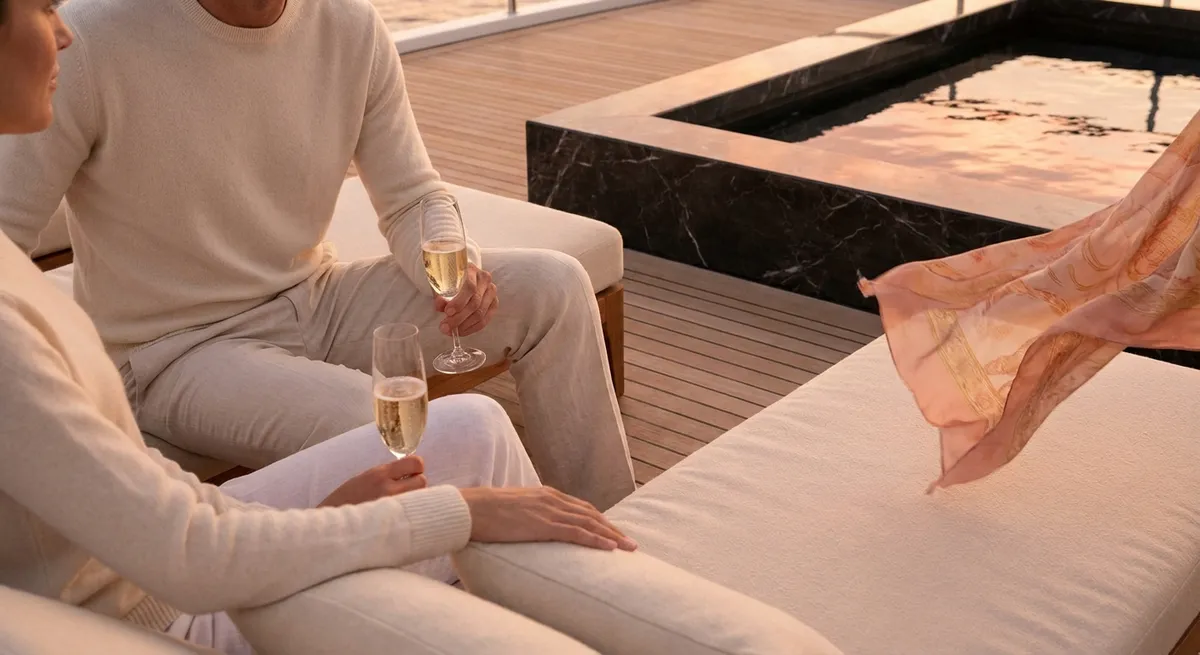
True connoisseurs pay attention to ceiling height, sightlines, and circulation: Can you move around the bed without turning sideways? Is there a natural “flow” from dressing area to bath to veranda? Are there places to place a book, a glass, a shawl, without resorting to precarious balancing acts?
Another subtle indicator: material transitions. The shift from soft carpeting in the sleeping area to smooth stone in the bath, to warm-toned decking on the balcony, gently orchestrates how you inhabit the space. On elite ships, these transitions are rarely accidental.
Exclusive Insight #1: When evaluating a luxury cruise, study the floor plan as closely as the square footage. The best suites are not simply large; they are architected for how discerning guests actually live at sea—reading, dressing, dining, working, and retreating without compromise.
The Invisible Choreography of Personalized Service
On the finest ships, service feels almost telepathic, yet never intrusive. That effect is not magic; it is choreography—built on ratio, training, and culture.
Luxury lines invest in unusually high staff-to-guest ratios, but the headline number tells only part of the story. The difference lies in how well information flows behind the scenes. Your preferred espresso order at breakfast becomes part of a discreet profile accessible to the bar team. Your inclination to dine later, your aversion to strongly scented amenities, your preference for a softer pillow—each touchpoint refines a living dossier designed only to serve you better.
The pinnacle is anticipatory service that respects boundaries. The butler who senses you want a quiet evening and adjusts course, the sommelier who notices you lingered over a particular white Burgundy and reserves the last bottle for your next dinner, the concierge who rearranges a private car transfer because you decided—on a whim—to linger ashore for sunset.
This kind of service requires genuine continuity. Crew members on the most refined lines often stay for years, moving between ships but not out of the brand’s ecosystem. That longevity translates into a kind of institutional memory; the ship begins to remember you, even if you have not sailed in several seasons.
Exclusive Insight #2: Ask about crew tenure and training philosophy, not just the staff-to-guest ratio. Long-serving teams with a shared service culture are the hidden architecture behind truly bespoke experiences.
Curated Shores: When Port Days Feel Like Private Invitations
In the luxury sphere, shore experiences are no longer a shopping list of excursions but a curated extension of the ship’s ethos. The most sophisticated lines are quietly building networks of local partners—chefs, curators, vintners, naturalists—who create experiences far removed from the bus-and-badge routines of mass tourism.
Think: a small-group visit to a family-run olive estate in the Peloponnese followed by a table set under fig trees, where the ship’s own chef collaborates with the owners for a one-off lunch. Or a pre-opening tour of a museum with its curator, ending in a private gallery tasting of regional wines. In the polar regions, it might be a Zodiac landing timed not only for weather but for the angle of light on a glacier, accompanied by a marine biologist who has spent seasons in that specific bay.
Crucially, these experiences are paced. Instead of compressing four stops into one day, discerning lines design immersive half- or full-day encounters that leave room for conversation, contemplation, and the unexpected. Transportation is often as considered as the destination: air-conditioned minivans replaced with comfortable, low-capacity vehicles; tenders scheduled to avoid queuing; port calls timed to arrive just after the crowds leave.
Exclusive Insight #3: Evaluate a line by the caliber and intimacy of its partnerships ashore. Look for evidence of named experts, limited-group access, and experiences that would be difficult to recreate independently—as opposed to generic sightseeing dressed in polished language.
Culinary Precision: Beyond “Fine Dining at Sea”
Most luxury cruisers expect white tablecloths and an impressive wine list. The real differentiators now lie in depth, restraint, and adaptability.
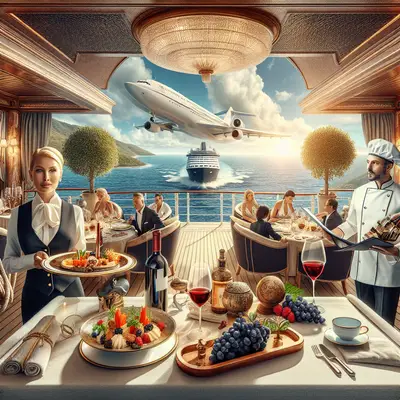
Depth appears in the sourcing trail. The finest ships will quietly disclose which caviar house they partner with, which single-origin beans are used in the café, which sustainable fisheries supply their seafood. Menus shift not only with the destination but with the micro-season: asparagus appearing in Northern Europe only when it is at its brief, glorious peak; stone fruits in the Mediterranean treated with the kind of respect usually reserved for truffles.
Restraint is visible when a brand chooses to do fewer venues, perfectly, instead of scattering a dozen underdeveloped concepts across the deck plan. One restaurant may focus solely on impeccably executed classics, another on destination-driven menus that change entirely every few days, and a third on chef’s table experiences with extremely limited seating.
Adaptability is perhaps the rarest quality. Luxury kitchens are increasingly able to accommodate sophisticated dietary needs without signaling “special treatment.” Gluten-free breads that rivals artisanal bakeries, vegan tasting menus that are plated and paired with the same seriousness as any other, low-sodium or allergy-conscious dishes prepared with visible craft rather than compromise.
Exclusive Insight #4: Ask how often menus change in full, how the ship sources regionally while maintaining consistency, and how the culinary team approaches dietary complexity. The answers reveal more about the ship’s gastronomic seriousness than any number of specialty restaurants.
The Quiet Luxury of Time: Itineraries That Breathe
What distinguishes a luxury itinerary is less the list of ports and more the tempo in which they unfold. Increasingly, sophisticated travelers are gravitating toward voyages that prioritize depth and rest over accumulation.
You see it in the proliferation of overnight stays in culturally rich cities—Lisbon, Tokyo, Cape Town—where guests are encouraged to dine ashore, attend performances, or simply wander, knowing their suite is waiting nearby. You see it in late departures from marquee ports, allowing sunset strolls and unhurried dinners long after the day-trippers have retreated.
Sea days, too, are being reconsidered not as filler but as purposeful interludes. On the most refined ships, they become canvases for serious enrichment: meaningful lectures by scholars with academic pedigrees, small-group workshops, curated wine flights with a master sommelier, or wellness programs designed as sequences rather than one-off classes.
Above all, there is a sense that the voyage has a narrative arc. Early days may be gentle, easing guests into the rhythm of the ship; mid-voyage might feature a climactic port or signature event; the final days often slow deliberately, creating space to absorb the experience rather than ending in a rush of disembarkation logistics.
Exclusive Insight #5: When comparing sailings, examine time in port versus total ports visited, the presence of overnight calls, and the quality of sea-day programming. Luxurious travel is as much about what is left out as what is included.
Conclusion
Luxury cruising, at its most compelling, is not a spectacle of excess but an art of calibration. It lives in the feel of a well-composed suite, the effortless fluency of discreetly shared information among crew, the intimacy of a shore experience that feels handcrafted, the seriousness with which a kitchen treats a single tomato, and the thoughtful pacing of days and nights at sea.
For cruise enthusiasts already attuned to the fundamentals, the real fascination lies in these subtleties—the invisible decisions that turn a voyage into a deeply personal chapter rather than just another itinerary. Discerning travelers are no longer asking, “Is this a luxury cruise?” They are asking, “Does this ship understand how I actually want to live, think, taste, and move through the world—for however many days I am entrusted to its care?”
Those who learn to read these finer signals will find that the most rewarding luxuries at sea are often the quietest.
Sources
- Cruise Lines International Association (CLIA) – 2024 State of the Cruise Industry - Industry report outlining trends in upscale and luxury cruising, including deployment and guest preferences
- Regent Seven Seas Cruises – The Suite Life - Illustrates how top-tier luxury lines conceptualize suite design, space, and amenities
- Silversea Cruises – S.A.L.T. Culinary Program - Example of destination-driven culinary and shore-excursion integration on a luxury line
- U.S. Department of Transportation – Cruise Ship Travel - Practical guidance for cruise travelers, useful context for evaluating wellness and safety standards
- Harvard Business Review – The Power of Quiet Leadership - Not cruise-specific, but illuminates principles of understated excellence and service cultures that parallel top luxury cruise operations
Key Takeaway
The most important thing to remember from this article is that this information can change how you think about Luxury Cruises.