In an era when social feeds are saturated with fleeting weekend getaways and “checked‑off” bucket lists, something very different is unfolding at sea. Major cruise lines are quietly leaning into a more theatrical, slow‑burn style of travel—world cruises that sell out in hours, grand voyages that circle hemispheres, and ultra‑long itineraries that turn the ocean itself into the main event.
From Royal Caribbean’s marathon “Ultimate World Cruise” igniting viral fascination on TikTok and Instagram, to MSC Cruises and Oceania unveiling increasingly ambitious grand journeys, 2024–2025 is proving that the appetite for extended, curated time at sea has never been stronger. Behind the headlines, though, the most discerning cruisers are noticing a deeper shift: the best lines are beginning to treat these sailings as living, evolving narratives rather than simple point‑to‑point transport.
Below, we unveil five quietly transformative dynamics that sophisticated cruise enthusiasts are watching closely right now—developments that are changing not just where we sail, but how the best cruise lines think about the voyage itself.
The Rise of the “Narrative Itinerary”: Cruises Curated Like a Season of Prestige TV
World cruises went from niche indulgence to mainstream headline the moment Royal Caribbean’s 274‑night “Ultimate World Cruise” began trending across social media platforms. Yet the most intriguing development isn’t their length; it’s their structure. Increasingly, leading brands are programming these long sailings with the intentionality of a limited‑series drama, grouping segments into distinct “chapters” that tell a cohesive story.
Oceania Cruises, for example, frames its extended journeys around culinary and cultural arcs—think “epicurean trail” segments through the Mediterranean and Middle East, or art‑forward explorations linking Northern Europe’s galleries with Iberian design. Silversea and Seabourn are doing the same for expedition‑leaning routes, treating Antarctica, the Kimberley, and the Northwest Passage as acts within a broader environmental narrative. The itinerary is no longer a list of ports; it’s a progression, with lectures, menus, and onboard programming designed to interlock. For the well‑traveled guest, this shift from “collection of stops” to “curated storyline” is what elevates a long voyage from impressive to unforgettable—and it’s precisely where the most forward‑thinking cruise lines are now competing.
Destination Duplication Is Out: Micro‑Ports and “Under‑the‑Radar” Days Are In
Globally, ports such as Barcelona, Venice’s nearby gateways, Santorini, and Mykonos remain anchor calls across fleets—but the high‑end guest’s gaze is drifting elsewhere. As destinations grapple with over‑tourism and capacity limits, premium and luxury lines are quietly redesigning deployment to weave in secondary and tertiary ports that feel almost private, yet remain logistically viable for large‑scale operations.
Recent Mediterranean schedules from lines like Azamara, Windstar, and even select itineraries from Celebrity and Princess reveal a striking pattern: more calls at lesser‑known islands, historic river ports, and working harbors where a ship still feels like an event. Places like Nafplio instead of only Piraeus, Trieste and Rijeka in place of a single marquee Adriatic stop, or smaller Cycladic islands that offer chartered experiences away from the crowds. Not coincidentally, these calls pair beautifully with social media’s current appetite for “I’ve‑never‑heard‑of‑this‑place” discovery.
For the connoisseur guest, the value lies in exclusivity of experience rather than price point. A quiet morning walk in a little‑visited fishing village or a private after‑hours museum opening in a compact port will always read as more rarefied than the standard panoramic bus tour of a congested capital city. Modern itineraries that intersperse flagship ports with intelligent “micro‑port” days feel considered, intentional—and the best cruise lines know that their most discerning repeat guests are reading deployment maps as carefully as wine lists.
The New Luxury Is Time: Sea Days as Crafted Experiences, Not Transit
As extended itineraries gain prominence, the humble sea day is undergoing a renaissance. What was once perceived as “down time between destinations” is becoming one of the most coveted components of the voyage—especially at the upper end of the market, where guests are deeply scheduled in their lives on land and increasingly crave unstructured luxury.
Lines across the spectrum are responding. Regent Seven Seas and Explora Journeys are elevating sea‑day programming into something akin to an onboard salon culture: small‑group conversations with visiting authors and architects, hands‑on ateliers for gastronomy and design, and wellness experiences that go far beyond a simple massage menu. Even larger premium lines—such as Celebrity with its Edge‑class ships or Princess with its newest Sun‑class innovations—are reimagining sea days with multi‑course chef’s tables, ship‑within‑a‑ship quiet enclaves, and curated music programming that flows from afternoon jazz to late‑night, low‑lit lounges.
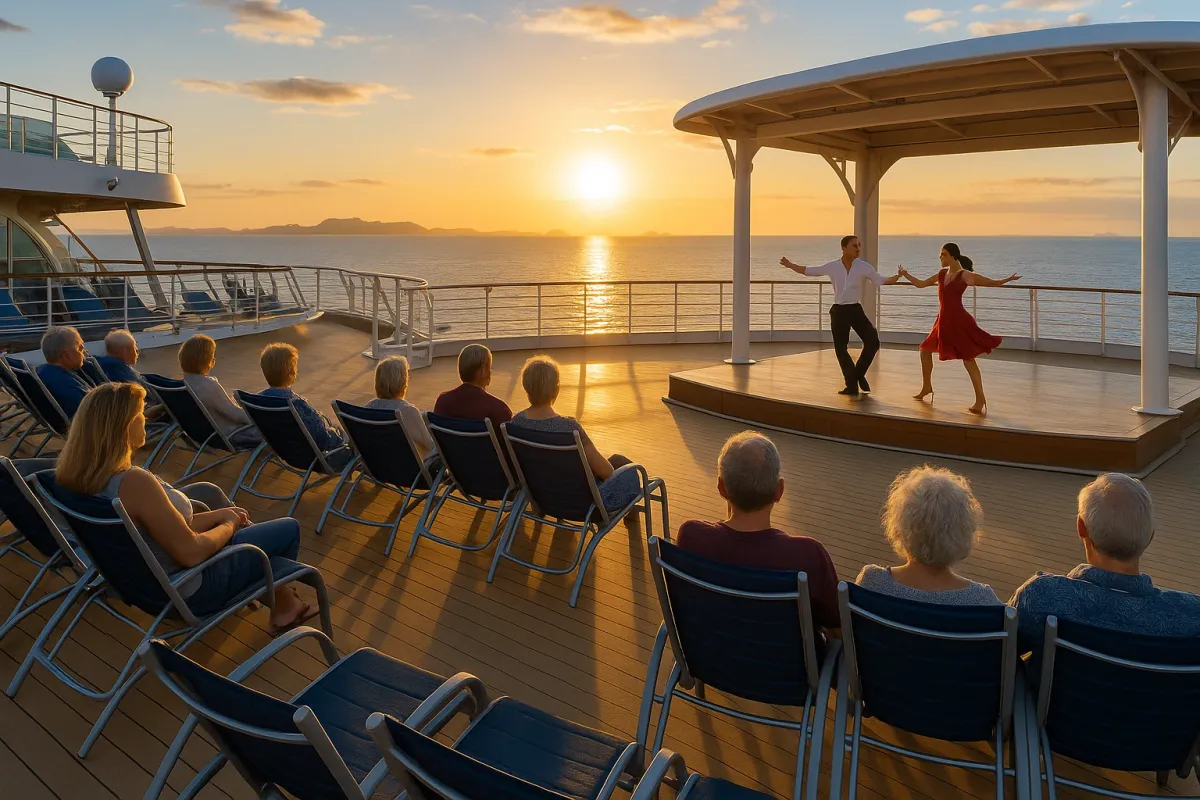
What matters most to the sophisticated cruiser is intentionality. A sea day that feels like a slow, beautifully paced itinerary in itself—poolside cabana service, a quietly excellent lunch with a serious wine by the glass program, a late afternoon lecture, sunset on a private balcony, then an intimate performance—offers something increasingly rare in modern travel: the luxury of time that feels neither wasted nor overfilled. The smartest cruise lines are turning these days at sea into their signature calling card.
Sustainability Moves from Talking Point to Design Principle
The environmental discussion around cruising has long been charged, but 2024–2025 marks a clear inflection point: propulsion choices and sustainability architectures are now visible differentiators in the premium cruise space, not just technical footnotes. Guests with the means and mindset to book extended sailings are beginning to scrutinize not just where a ship goes, but how it moves through the water.
Consider the current wave of LNG‑powered newbuilds across major brands—MSC, Carnival Corporation lines, Royal Caribbean Group, and others—or the next generation of hybrid and shore‑power‑ready vessels in Europe and the Norwegian coastal trade. Expedition‑specialists like Hurtigruten and Ponant continue to push hybrid and battery‑assisted solutions, while lines such as Norwegian Cruise Line Holdings and Royal Caribbean are publicizing investments in methanol‑capable ships and advanced waste‑heat recovery systems. For the connoisseur traveler, these details increasingly factor into line selection the way cabin categories once did.
Yet the more subtle shift lies in how sustainability informs the onboard experience. Fine‑dining venues highlighting low‑impact ingredients and regional sourcing, bar programs that reduce single‑use elements without sacrificing sophistication, curated shore excursions that partner with small, locally owned operators, and itineraries designed to reduce unnecessary high‑speed sprints between ports—all of these signal to the guest that sustainability is no longer mere messaging. In the years ahead, the lines that treat environmental stewardship as a design principle rather than a compliance checkbox will be the ones that win the loyalty of the most informed cruisers.
The Quiet Privatization of the Big Ship: Ship‑within‑a‑Ship Concepts Come of Age
While small luxury vessels continue to attract purists, the most intriguing trend for many seasoned cruisers is unfolding at the intersection of scale and seclusion. Ship‑within‑a‑ship concepts—MSC Yacht Club, Norwegian’s The Haven, Celebrity’s Retreat, and similar enclaves—are evolving into fully realized luxury ecosystems, offering the intimacy and personalization of a small vessel fused with the spectacle and amenity‑rich environment of a megaship.
What began as simply “a better suite class” has, on the latest hardware, transformed into coherent micro‑resorts at sea: private pools and sun decks, dedicated restaurants with menus distinct from the rest of the ship, priority tendering, exclusive concierges, and reserved entertainment seating that feels more like a member’s club than an upgrade. As brands like MSC continue their aggressive global expansion with increasingly lavish Yacht Club zones, and Norwegian refines The Haven on its Prima‑class, the proposition for discerning guests becomes clearer: the ability to step in and out of the larger ship’s energy at will.
For the sophisticated cruiser, this hybridization offers the best of both worlds. One can spend a quiet morning in a private enclave with crafted coffee and a near‑empty pool, then step into the ship’s broader universe for a Michelin‑adjacent specialty restaurant or a large‑scale production show. On social media, these enclave experiences photograph particularly well: hushed, design‑forward spaces perched above the bustle, conveying an aesthetic of “elevated escape” that feels far removed from the old clichés of crowded pool decks. It is no accident that cruise lines are highlighting these visuals in current marketing campaigns—the future of big‑ship luxury may be less about cabin square footage and more about the quality of the micro‑world wrapped around it.
Conclusion
Cruising in 2024–2025 is being reshaped less by flashy novelties and more by a profound rethinking of what a voyage can be. World cruises and grand journeys are no longer just lengthy itineraries; they are narrative experiences. Micro‑ports are emerging as the new currency of connoisseurship. Sea days have become curated interludes of time wealth. Sustainability is quietly dictating design and deployment. And on the largest vessels afloat, a discreet layer of private, club‑style luxury is rewriting the rules of scale.
For the traveler who sees the ship not as a floating hotel but as an evolving stage on which their journey plays out, this moment in cruising is rich with possibility. The most rewarding decision you can make now is not simply which line or route to choose, but which philosophy of voyage speaks most clearly to how you wish to inhabit your time at sea.
Key Takeaway
The most important thing to remember from this article is that following these steps can lead to great results.