The modern cruise landscape is not a flat sea of options; it is a finely layered world of brands, sub-brands, and unspoken hierarchies. To the uninitiated, ships may appear interchangeable—gleaming white hulls distinguished only by color schemes and logos. But for the connoisseur, cruise lines reveal themselves more like wine estates: house styles, micro-climates of service, and cellar doors that only open if you know where, and how, to knock. This is the realm where loyalty is curated, experiences are engineered with precision, and access—not price alone—becomes the true currency.
Mapping the Cruise “Constellations”: Families, Not Just Brands
Most frequent cruisers know the names—Royal Caribbean, Carnival, Norwegian, MSC. Fewer fully appreciate that many of these operate as “constellations” of brands, each carefully positioned to speak to a different traveler and price point while quietly sharing back-end infrastructure, technology, and even crew training.
Under Carnival Corporation, for example, you’ll find Carnival Cruise Line, Princess Cruises, Holland America Line, Cunard, Seabourn and others. The apparent variety disguises a deliberate structure: Carnival for mass-market fun, Princess for premium mainstream, Holland America for classic and destination-focused, Cunard for heritage and formality, Seabourn for ultra-luxury. Royal Caribbean Group similarly spreads its portfolio, from Royal Caribbean International to the more intimate luxury of Silversea and the Scandinavian-inflected refinement of Azamara (until 2021) and now its joint venture with TUI Cruises.
For the attentive guest, understanding these families unlocks strategic decision-making. You can, for example, progress from a line’s “gateway” brand into its more elevated sister as your tastes evolve, often leveraging past loyalty in nuanced ways. You can also read between the lines of fleet announcements: when a parent company invests in certain technologies or culinary partnerships on one brand, it often quietly signals where the rest of the portfolio is heading over the next decade.
The Hidden Currency of Loyalty: When Status Outweighs Suite Category
To many new cruisers, luxury is measured in square footage and balcony depth. Experienced guests know that, over time, your most valuable asset is not the cabin category you book, but the loyalty tier you hold. Status—Platinum, Diamond, Pinnacle, Elite—reshapes a voyage in ways that rarely appear in the glossy brochure.
Loyalty benefits increasingly move beyond complimentary laundry and welcome cocktails into subtler, more consequential advantages: priority for sold-out shore excursions, early access to new itineraries before they reach the public, invite-only culinary events with the executive chef, and, in some cases, unadvertised “soft upgrades” when occupancy quietly allows for it. On certain lines, high-tier loyalists can secure preferred dining times during peak seasons that even suite guests may struggle to obtain.
More discreet still is cross-recognition between sibling brands. While not universal, some cruise families have experimented with partial reciprocal benefits—translating your history with a contemporary brand into privileged access on the ultra-luxury line in its stable. The math is compelling for the cruise line: cultivating a lifelong guest within the group rather than a single brand. For the traveler, it can function as a velvet bridge from premium to ultra-luxury, transforming what might have felt like a leap into a natural next step.
The Art of “Ship Personality”: How Lines Shape Atmosphere Without Saying So
Every cruise line publishes brochures about dining, entertainment, and itineraries. What they seldom articulate—and what seasoned enthusiasts prize—is ship personality: the intangible yet absolutely deliberate atmosphere onboard. This is engineered as carefully as any theater production.
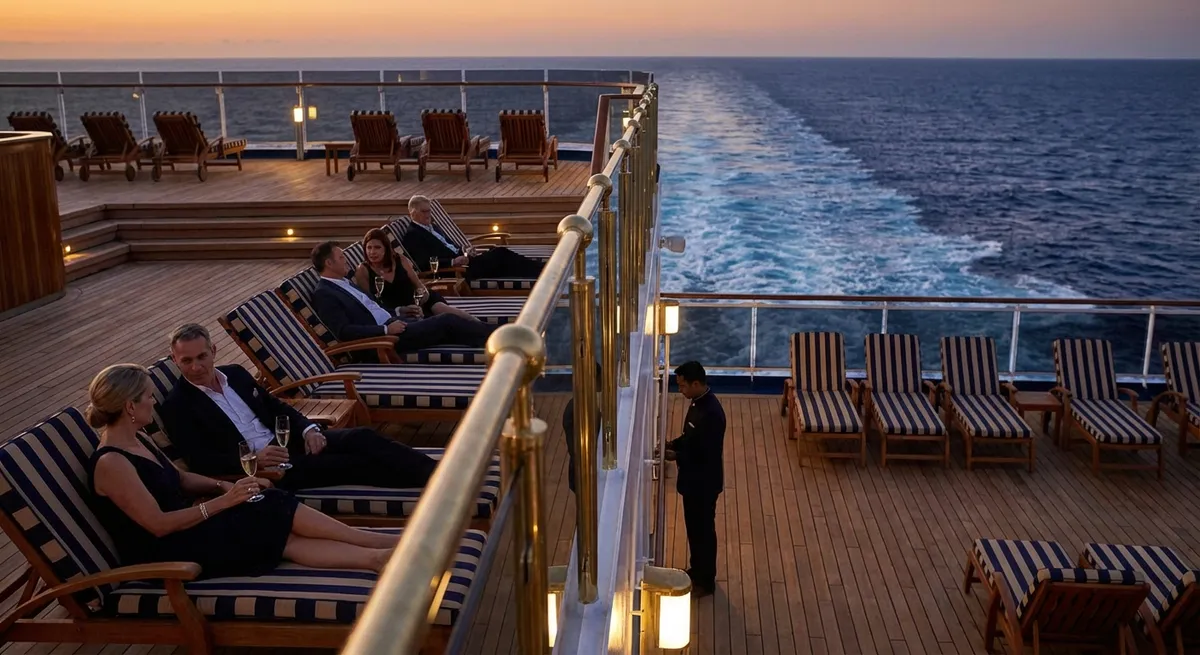
Consider lighting: some lines maintain bright, casino-like common spaces that encourage sociability and movement, while others embrace low, warm lighting and hushed corridors that seem designed for late-evening conversation and a second digestif. Sound design is equally distinctive. On certain ships, live music fills nearly every public venue in the evening, from piano bars to Latin lounges; elsewhere, sound is curated sparingly, allowing the quiet to speak as loudly as an orchestra.
Décor is another form of coded messaging. An atrium lined with LED screens and kinetic sculptures sends a fundamentally different signal than one framed in polished wood, art photography, and a string quartet. Both are intentional. Cruise lines know that travelers self-select into these worlds, and that ship personality functions as a soft filter, guiding guests toward the floating “neighborhood” where they instinctively belong.
Enthusiasts who pay attention to this artistry learn to read newbuild design reveals and refurbishment plans like a script: changes to lounge configurations, the addition of chef’s tables, or the relocation of spa entrances all hint at where a line is positioning itself—and whether its trajectory continues to align with their own tastes.
The Shore-Side Signature: How Itineraries Reveal a Line’s True Ambition
Marketing copy may promise “immersive itineraries,” but a cruise line’s true shore-side philosophy is revealed in the details: time in port, overnights, tender vs. dock, and the degree to which curated excursions reflect local culture rather than a standardized template.
Lines with a destination-first DNA are increasingly shifting from brief, daytime calls to extended stays and overnights in ports such as Venice (when permitted), Reykjavik, or Tokyo, allowing guests to experience cities at dusk and dawn, not just alongside fleets of tour buses. Others specialize in “scenic cruising” days—gliding past glaciers, fjords, or volcanic coastlines—where the ship itself becomes a viewing platform and the commentary is led by expedition guides rather than cruise directors.
The sophistication of shore programs can vary dramatically, even within the same price tier. Some lines now offer private, small-group visits to family-owned vineyards, after-hours museum access, or culinary experiences in the homes of local chefs. For the guest who values rarity over volume, these touches matter far more than the number of ports on an itinerary.
A subtle but meaningful tell: how a line behaves when conditions change. Lines deeply invested in destination integrity will reconfigure schedules to avoid overcrowded ports or environmental strain, sometimes at commercial cost, because they recognize that long-term desirability of a region is part of their own brand equity. Guests watching closely can sense which brands are playing the long game.
The Quiet Layer Above Luxury: Residences, Buy-Ins, and Semi-Private Worlds
Beyond suites and ship-within-a-ship enclaves lies a tier that even many seasoned cruisers rarely encounter: residential and semi-private experiences that blur the lines between cruising, second-home ownership, and ultra-bespoke travel.
Residential ships such as The World have long operated as floating private communities, where apartments are owned rather than booked, and journeys are planned years in advance around global cultural events and seasonal highlights. A new generation of residence-at-sea concepts, including luxury brands entering the maritime residential space, is poised to expand this model, offering fractional ownership and curated lifestyle programming, often with fewer ports and longer stays.
At the same time, mainstream and premium lines are elevating their ship-within-a-ship products—The Haven, Yacht Club, or private deck-and-lounge complexes—into increasingly self-contained micro-resorts with dedicated dining, butler service, and priority tendering that insulate guests from the busier rhythms elsewhere on board. These are not simply “nicer cabins”; they’re parallel universes stitched into a single hull.
For the enthusiast, this tier poses an intriguing question: when does a cruise cease to be a trip and become a lifestyle? For some, the answer is found in purchasing a residence at sea; for others, it’s in committing to a particular line’s top-tier product on every voyage, transforming the ship into a familiar private club that just happens to change continents between visits.
Conclusion
To understand cruise lines at a sophisticated level is to look past livery and logos and instead read the quieter signatures: how a brand shapes loyalty, orchestrates its onboard personality, authors its relationship with destinations, and experiments at the fringe of what “cruising” can be. The most rewarding experiences tend to emerge not from chasing the newest vessel or the highest suite category, but from aligning with a line whose philosophies—spoken and unspoken—match your own cadence of travel.
In this sense, cruise enthusiasts become less like passengers and more like curators, assembling a personal portfolio of lines and ships that suit different moods, companions, and seasons of life. The sea remains constant; the art lies in choosing the right floating world from which to experience it.
Sources
- [Cruise Lines International Association (CLIA): 2023 State of the Cruise Industry](https://cruising.org/en/news-and-research/research/2023/state-of-the-cruise-industry-2023) - Industry overview on growth, demographics, and evolving trends in cruise travel
- [U.S. Federal Maritime Commission: Cruise Passenger Information](https://www.fmc.gov/resources-services/cruise-passenger-information/) - Background on regulatory context and cruise line oversight
- [Carnival Corporation Brands Overview](https://www.carnivalcorp.com/brands) - Official breakdown of the Carnival Corporation brand family and market positioning
- [Royal Caribbean Group: Our Brands](https://www.royalcaribbeangroup.com/our-brands/) - Corporate overview of Royal Caribbean Group’s portfolio and strategic focus
- [The World Residences at Sea – Official Site](https://aboardtheworld.com/) - Insight into the residential ship model and how it differs from traditional cruising
Key Takeaway
The most important thing to remember from this article is that this information can change how you think about Cruise Lines.