There is a particular kind of luxury at sea that rarely appears in glossy brochures. It lives in the unpublicized corners of the ship, the timing of a service rather than its ostentation, and in the delicate choreography between privacy and privilege. For travelers who already know the difference between “nice” and “exceptional,” the true pleasure of a luxury cruise lies in details that most guests never notice—but that quietly transform the experience when you do.
Below, we explore five exclusive, often-unspoken insights that discerning cruise enthusiasts increasingly seek out and compare once the gangway is raised.
The Architecture of Privacy: How Ships Hide Their Best Spaces
On a luxury vessel, privacy is not a line item—it is a design principle.
The best ships are engineered around controlled visibility: sightlines that allow you to feel connected to the sea yet subtly screened from other guests. Look for stateroom decks where corridors are staggered rather than straight, so you never look directly into a neighbor’s doorway. On ultra-luxury lines, top suites may be placed slightly aft or on “half decks” accessed by discreet staircases, intentionally separating them from the busiest elevator banks.
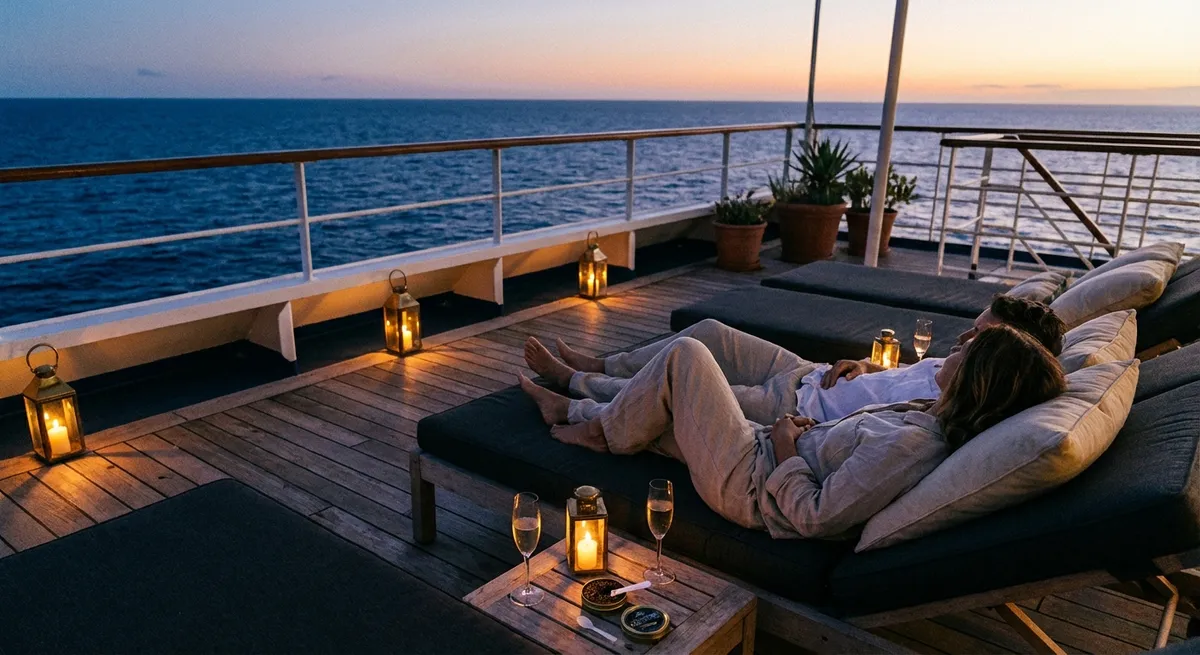
Out on deck, the true measure of a high-end ship is not the size of the pool but the seclusion of the surrounding space: windbreaks positioned to shield loungers from casual traffic, shaded alcoves framed by planters rather than ropes, and quiet zones that are circulation dead-ends by design. Some newer ships locate their most exclusive sun decks in seemingly inconvenient locations—a deliberate choice to discourage wandering.
For the refined cruiser, a pre-cruise study of deck plans becomes a form of quiet reconnaissance. Noticing where crew corridors intersect guest spaces, where service pantries are positioned relative to suites, and which public venues are above or below your chosen cabin can tell you far more about your future experience than any marketing photograph.
The Invisible Service Ballet: Timing, Not Just Talent
On a truly luxurious cruise, the finest service moment is often the one you never see happen.
What distinguishes top-tier lines is not only the ratio of crew to guests, but the meticulous choreography of when service occurs. Cabin stewards who seem to “magically” appear only when you are out, bartenders who remember your preferences after a single order, and waitstaff who adjust pacing without a word—all of this reflects an underlying system of observation and communication.
Many luxury ships quietly employ technology that enables this ballet: door sensors that confirm you’ve left the suite, digital notes shared between bar and dining teams about your preferred varietals, and handheld devices that allow butlers to track your daily rhythms. Yet the sophistication lies in restraint. On better lines, staff are trained to interpret these signals as suggestions, not scripts—giving each encounter the spontaneity of genuine hospitality rather than algorithmic efficiency.
As a guest, you can gently “tune” this ballet. A brief conversation with your butler or suite attendant on day one—about your preferred housekeeping times, how you like your breakfast coffee, whether you enjoy conversation or quiet—often yields a level of tailored service that feels less like a hotel stay and more like being cared for in a private estate at sea.
Culinary Depth Beyond the Headline Restaurant
The hallmark restaurants on luxury ships—the name-brand chef venues, the jewel-box dining rooms—are important, but they are not where connoisseurs quietly judge a line.
The real test lies in the culinary depth that hides behind the obvious: room service, poolside menus, and how the kitchen handles “off-script” requests. On the most refined ships, you will notice that the simplest items are executed with the same rigor as the theatrical dishes: poached eggs that arrive at perfect temperature, a late-night club sandwich with precisely balanced seasoning, a fruit plate that reflects what is ripe locally that week, not just what keeps well in cold storage.
Wine programs offer another layer of subtlety. High-end lines may advertise their grand labels, but enthusiasts increasingly look for the nuance of by-the-glass selections, depth in mid-tier bottles, and the sommelier’s willingness to pour off-menu options from the ship’s private allocations. On smaller luxury vessels, it is not uncommon for the head sommelier to quietly open a rare bottle for a small group in an underutilized lounge, turning an ordinary sea day into a memorable tasting.
If culinary sophistication matters to you, don’t simply book the most talked-about specialty venue. Study the daily menus, note how frequently dishes change on longer itineraries, and pay attention to how the kitchen leverages local sourcing—fresh fish loaded in Iceland, produce procured in Sicily, spices bought in Singapore. This is where the difference between “good food” and a truly gastronomic voyage becomes unmistakable.
The True Value of Space: Ratios, Not Square Footage
Marketing materials celebrate square meter counts, but seasoned luxury cruisers quietly examine a different metric: space per guest.
High-end ships increasingly publish guest-to-space ratios, a figure that reveals how much public real estate is effectively allocated to each passenger. Two ships might offer similar total tonnage, yet the one carrying fewer guests will feel calmer, more breathable, and infinitely more luxurious—even if the suites are slightly smaller on paper.
This sense of spaciousness manifests in subtle ways: unhurried breakfast service without queues, uncrowded elevators at peak times, loungers that are available without the morning “towel ritual,” and lounges where you can always find an intimate corner. The ship’s energy feels composed rather than congested.
Savvy travelers also consider acoustic space. On thoughtfully designed luxury ships, noise-dampening materials are integrated into ceilings, wall treatments, and even furniture upholstery. The result is a hushed ambiance in corridors and lounges, where conversation remains private without needing to raise your voice over ambient sound—a small but powerful detail for those who value discretion.
When comparing itineraries, look beyond the size of your suite. Examine how many guests the ship carries at full capacity, how many dining venues are available without surcharge, and whether open-deck space is tiered across multiple levels. In luxury cruising, the most precious amenity is often the one you cannot photograph: the feeling of never having to compete for space.
Itinerary as Signature: Reading a Line’s Philosophy in Its Routes
For the connoisseur, a cruise line’s true character reveals itself not in its décor but in its itineraries.
Luxury lines that take their craft seriously display a kind of curatorial intelligence in route planning. Rather than chasing only marquee ports, they blend iconic cities with under-the-radar harbors that require smaller ships, careful navigation, or special permissions. These are itineraries that might linger late in a port to coincide with a local festival, arrange early-morning arrivals timed with sunrise, or schedule an overnight stay where most ships simply call for the afternoon.
Look especially at port sequencing and time in port. A thoughtful itinerary balances demanding sightseeing days with restorative sea days, preventing the journey from devolving into a succession of rushed excursions. On some of the most sophisticated voyages, sea days are placed after destination-heavy clusters, giving guests time to absorb what they’ve experienced rather than simply collecting ports.
Another subtle indicator is how a line uses tender ports—destinations where ships anchor offshore and guests transfer by tender boats. Inconvenient for mass-market ships, these can be a telltale sign of a line’s commitment to reaching more exclusive or protected locations. Smaller luxury vessels, often built to navigate narrow channels or shallow harbors, turn these into signature moments: gliding past coastal villages at dawn, or anchoring in quiet bays that larger ships can only pass at a distance.
To understand whether a line aligns with your sensibilities, read its itineraries the way one might read a wine list: not for the obvious names, but for the thoughtful inclusions and the confidence to offer something a little less familiar.
Conclusion
The true luxuries of modern cruising rarely shout. They whisper—in the curve of a private deck, the precision of quiet service, the intelligence of an itinerary designed for people who value depth over spectacle. For those who already understand that sophistication is not about excess but about intention, these subtler distinctions are what make one voyage unforgettable while another fades into pleasant sameness.
Approach your next cruise as a study in these veiled luxuries. Read the deck plans as closely as the brochure, speak candidly with your butler or concierge, and allow the quieter layers of the ship to reveal themselves. In that space between what is marketed and what is actually experienced, you will find the real art of luxury at sea.
Sources
- CLIA Global Cruise Industry Outlook – Cruise Lines International Association data on ship sizes, guest capacities, and industry trends
- Seabourn – The Seabourn Experience – Example of how an ultra-luxury line frames service, space, and itineraries
- Regent Seven Seas Cruises – The Suite Life – Insight into suite design, privacy considerations, and space allocation on a luxury brand
- U.S. Department of Transportation – Maritime Services – Background on maritime operations and port access considerations
- Cornell University School of Hotel Administration – Hospitality Research – Academic perspective on service design, guest experience, and luxury hospitality principles
Key Takeaway
The most important thing to remember from this article is that this information can change how you think about Luxury Cruises.