Some ports reward your arrival by air. Others only make sense when you glide in by water—where the skyline, the working harbor, and the small human details align into a single, cinematic frame. For the seasoned cruiser, the real luxury is not merely where you go, but how each destination chooses to reveal itself as the ship approaches, anchors, and departs.
This is an exploration of coastal cities that unfold their character most elegantly from the waterline—and five quiet, insider insights that turn a beautiful arrival into a truly memorable encounter.
The First Impression: Reading a City From the Wake
A harbor is never just infrastructure; it is a city’s original handshake. Watch closely as you approach: the choreography of tugboats, the pace of waterside foot traffic, the tilt of fishing boats against glass towers. These details say more about a place than any shore excursion brochure.
Marseille’s layered limestone ridges rising behind the Vieux-Port, Lisbon’s pastel facades cascading down to the Tagus, Valletta’s sandstone bastions guarding an indigo inlet—each is a living archive of commerce, conflict, and culture. Arriving by sea restores a lost narrative: you see why fortifications stand where they do, why warehouses cluster at certain bends, why old quarters cling to elevation.
The refined cruiser learns to “read” a port on approach. Are there working shipyards still active? Do ferries slice insistently across your bow? Does the city present its monuments proudly to the water, or hide them just out of view? This habit not only deepens appreciation, it subtly prepares you for what awaits ashore: a place still shaped by maritime life, or one that has turned its back on the sea.
Coastal Cities That Are Best Met From the Water
Some destinations only reveal their logic when you first encounter them from the vantage point of a ship’s rail.
Venice, of course, is the archetype: a city whose streets are liquid, where logistics and romance share the same canals. Approaching its lagoon, even on alternative anchoring routes now used to protect its fragile fabric, you understand that this is a place designed to be reached by water, not merely admired from it.
Stockholm and its archipelago offer a more northern expression of the same idea. For hours before you tie up, skerries scatter across the horizon, dotted with summer houses and discreet jetties. The city eventually reveals itself not with a single skyline, but as a composed series of neighborhoods, each framed by water and woodland.
In the Mediterranean, Dubrovnik’s walled Old Town presents a different kind of seaborne encounter: a fortressed jewel box that seems almost theatrical when viewed from offshore, its terracotta rooftops cascading toward the Adriatic. Arrival here is not just picturesque; it’s explanatory. The walls, the watchtowers, the compact plan—everything is calibrated to the sea.
Farther afield, Hong Kong’s Victoria Harbour and Sydney’s natural amphitheater remind you that modern global cities can still be best understood from the deck: the alignment of iconic structures with navigable channels is no accident, but a lingering testament to their maritime DNA.
Five Quiet Insights for the Attentive Cruise Enthusiast
Certain subtleties are rarely mentioned in brochures, yet they transform how you experience a destination from the sea. These five insights, while understated, resonate deeply with those who relish the art of the voyage as much as the port itself.
1. The Magic Hours: Arrivals and Departures as Private Performances
While many guests focus on what happens in port, the most poetic moments often unfold just before arrival and just after departure. Civil twilight—in the 30 to 45 minutes on either side of sunrise or sunset—softens the skyline, catches stonework in a gentle glow, and reveals silhouettes you miss under midday glare.
In places like Santorini’s caldera or Quebec City along the St. Lawrence, this half-light is transformative. Plan to be on a forward-facing deck at least 20 minutes before the published ETA or sail-away; the actual visual drama often begins earlier than the official schedule suggests. For photographers, this is the time when water, sky, and architecture find their most flattering balance.
2. The Working Waterfront: Where Authenticity Lives
Beyond the polished cruise terminal lies the truest expression of a port: its working waterfront. Even in very refined destinations, the unvarnished edges are where you see how a city feeds itself, fuels itself, and maintains its vessels.
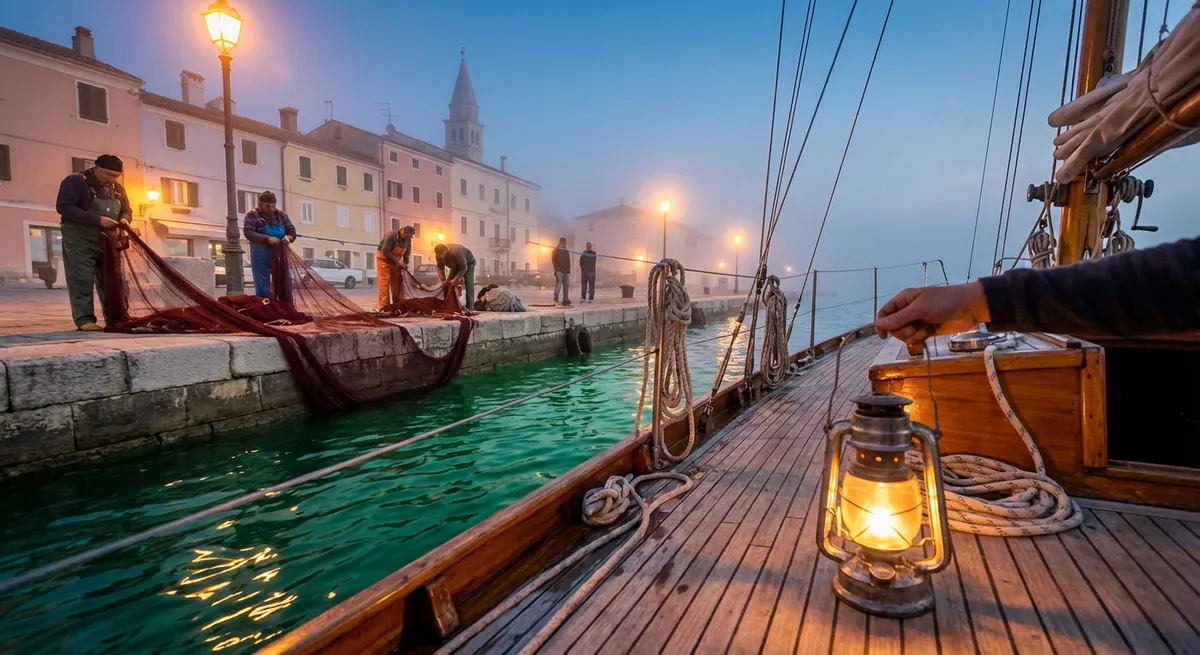
Look for fish markets you can see from the ship, modest repair yards, or clusters of small commercial craft. In Reykjavik, Bergen, or even Marseille, a short walk along the commercial quay can be more revealing than a curated shopping street. For those who appreciate authenticity without spectacle, a quiet hour observing the routines of dockworkers and fishermen can be as compelling as any formal tour.
3. Micro-Climates of Experience: Choosing the Right Season for Each Port
The most sophisticated itineraries are less about chasing perpetual sunshine and more about aligning destinations with their most revealing seasons. Some cities are best visited in their shoulder periods, when the air carries a particular clarity and the harbors reclaim a local rhythm.
The Baltic capitals have a very different soul in late May versus high July; the Mediterranean’s great cities breathe more easily in October, when the light is lower and the sea still warm. In places like Vancouver or Auckland, even the interplay of mountain weather and harbor fog in spring or autumn can lend an extra layer of atmosphere to arrival and departure. Selecting sailings that intersect with these seasonal nuances turns familiar ports into richer experiences.
4. Offshore Vantage Points: Staying Aboard When Everyone Goes Ashore
It is one of the quiet luxuries of being well-cruised: knowing when to resist the reflex to disembark. In certain ports, particularly those you have visited before, there is immense pleasure in experiencing the harbor from an almost-private ship.
When the majority of guests head into town, public spaces often empty. This is the moment to choose a shaded corner of an open deck, order a coffee or a perfectly made Negroni, and observe the harbor at its most honest: pilots boarding, ferries darting, cargo being moved. In ultra-busy destinations such as Barcelona or Naples, viewing the city from a serene, half-empty ship can feel more exclusive than any VIP lounge ashore.
5. Harbor to Hinterland: Reading the Landscape Beyond the Port
The view from the rail isn’t only about the waterfront; it is also an introduction to the geography that shaped the city. A refined cruiser uses this moment to decode the larger landscape before stepping ashore.
In Cape Town, Table Mountain’s sheer cliffs explain the city’s orientation; in Kotor, the fjord-like bay reveals why this enclave developed such a distinct maritime identity. In Alaska’s Inside Passage, the proximity of forested slopes to the dock tells you more about local life and logistics than any brochure could. By the time you reach the gangway, you are already in quiet dialogue with the place, its topography, and its history.
Crafting a Destination Portfolio Around the Sea Itself
For travelers who have already “done” the marquee ports, there is a distinct pleasure in curating itineraries not around country counts or bucket-list landmarks, but around styles of harbor and coastline.
You might favor journeys that stitch together historic fortified ports—Valletta, Cartagena, Kotor, Corfu—where stone walls meet deep water. Or perhaps you gravitate toward itineraries defined by archipelagos and intricate approaches: Greece’s Dodecanese, Sweden’s outer islands, the scattered atolls of French Polynesia, or Japan’s Seto Inland Sea.
Equally compelling are sailings that explore river-sea thresholds: places like Bordeaux along the Garonne, or New Orleans on the Mississippi, where ocean-going vessels penetrate inland and the character of the city reflects both maritime and riverine cultures. These transitions often result in the most interesting waterfronts and, consequently, the most rewarding arrivals.
By thinking in terms of harbor typology—natural amphitheaters, lagoons, fjords, estuaries, archipelagos—you move beyond a checklist of cities into a personal, highly textured map of experiences.
Conclusion
For the discerning cruiser, a destination is not just a point on a map; it is a sequence of impressions that begins far beyond the pilot boat and continues long after the last line is cast off. Some cities disclose themselves instantly; others reveal their layers only as the ship’s wake stretches behind you.
To stand at the rail in those in-between moments—twilight approaches, quietly observed workdays on the quay, departures that frame a skyline in receding perspective—is to rediscover why travel by sea remains uniquely expressive. The world’s finest coastal cities are not just places to be visited; they are stages upon which the sea, the ship, and the shore perform a shared, endlessly varied play.
Sources
- UNESCO World Heritage Centre – Venice and its Lagoon – Background on Venice’s maritime heritage and the significance of its lagoon setting
- UNESCO World Heritage Centre – Old City of Dubrovnik – Historical context for Dubrovnik’s walled seafront and its defensive relationship with the Adriatic
- Port of Stockholm – Cruise Traffic – Official information on approaches, terminals, and the archipelago setting around Stockholm
- Sydney Harbour – New South Wales Government – Overview of Sydney Harbour’s geography and landmarks as seen from the water
- U.S. National Park Service – Glacier Bay National Park – Insight into how seaborne approaches shape visitor experience in Alaska’s fjord-like environments
Key Takeaway
The most important thing to remember from this article is that this information can change how you think about Destinations.