For seasoned cruisers, the choice of cruise line is less about a ship and more about a philosophy. Beyond glossy brochures and broad brand slogans, each line cultivates its own vocabulary of service, design, and ritual—subtle cues that quietly signal whether a voyage will feel like a private club, a small grand hotel, or a cosmopolitan resort at sea. Understanding these nuances turns cruise selection from a basic booking decision into a finely tuned act of curation.
This guide explores how top-tier cruise lines differentiate themselves beneath the surface—and reveals five exclusive, insider-level insights that discerning travelers increasingly use to shape their next sailing.
The Signature DNA of a Cruise Line
Every serious cruise line, particularly in the premium and luxury space, has a recognizable “signature DNA” that runs through its fleet. It’s expressed not only in obvious elements like stateroom categories and dining formats, but also in the cadence of the day, the aesthetic of public spaces, and the extent to which the ship feels like a retreat versus a stage.
Some lines lean into a residential sensibility—muted palettes, library-like lounges, and dining that mirrors an upscale city neighborhood more than a traditional cruise ship. Others embrace a polished resort personality, where entertainment, social energy, and bold design play a central role. A few, especially in the small-ship and expedition segments, favor purposeful understatement, allowing destination immersion to take precedence over spectacle.
The most refined cruise lines fine-tune this identity with remarkable precision. You’ll often find a recurring thread: perhaps Nordic minimalism in spa design, European hotel-school rigor in the dining rooms, or a distinctly “members’ club” tone in guest interactions. Over time, experienced cruisers learn to read these details as clearly as a connoisseur reads a wine list.
Service Philosophy: Anticipation versus Attraction
One of the most telling ways to differentiate cruise lines is to look at their approach to service: is it primarily anticipatory or primarily performative?
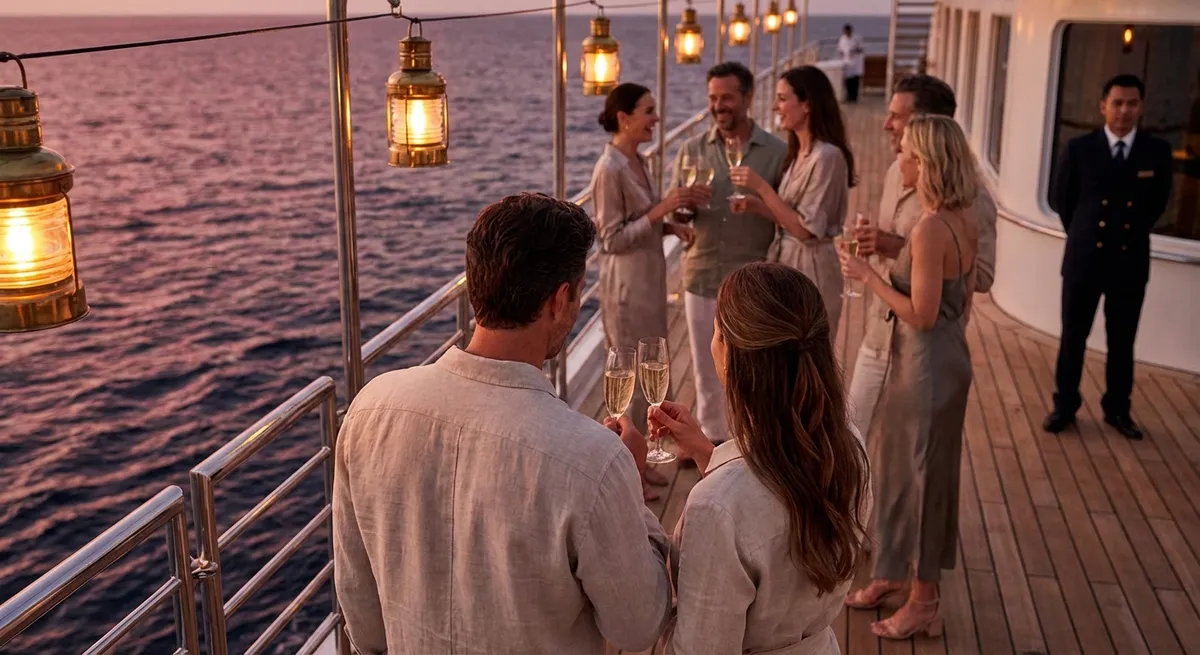
Luxury and upper-premium lines increasingly prioritize anticipatory service—crew quietly learning guest preferences within the first 24–48 hours and adjusting everything from pillow types to preferred aperitifs without a word being spoken. On these ships, the staff’s confidence comes not from scripted friendliness but from their ability to read the room: when to engage, when to step back, when to redirect attention from a less-than-ideal moment without fanfare.
By contrast, lines with a more resort-like ethos often emphasize visible, high-energy hospitality. Think enthusiastic greetings, activity-driven engagement, and entertainment that actively seeks participation. This is not inherently less refined, but it suits a different traveler: one who enjoys a vibrant social stage rather than a low-key salon atmosphere.
Discerning cruisers increasingly ask not “Is the service good?” but “What kind of service do I want?” A line that excels at exuberant interaction may not satisfy guests seeking a near-invisible, butler-led experience—and vice versa. Understanding this philosophical divide can prevent mismatched expectations before they ever reach the gangway.
Design as a Quiet Statement of Intent
Ship design has become a powerful—and often underappreciated—indicator of how a cruise line sees its guests. The arrangement of a ship’s spaces, the visibility of the sea from key venues, and even the acoustics of main lounges express a clear point of view.
At the refined end of the spectrum, several lines have pivoted toward deliberately residential interiors: art collections curated in partnership with galleries, textured fabrics in muted tones, and lighting that favors warmth and shadow over theatrical brightness. Public rooms are scaled to feel like interconnected salons rather than a single, cavernous theater. The intention is to encourage lingering conversations and a sense of belonging, rather than constant movement from show to show.
Other lines invest in dramatic architectural gestures: multi-deck atriums, glass-walled lounges cantilevered over the ocean, and rooftop pool decks that resemble private beach clubs. Here, the ship is the destination, especially attractive on itineraries where days at sea are a design feature rather than a logistical necessity.
Sound management is another subtle design signal. Ships aimed at a more sophisticated audience often build in deliberate sound “buffers” between entertainment and residential spaces: corridors that curve, stairways that divert sound, and lounges that allow for live music without overpowering conversation. For guests who value quiet luxury, these architectural decisions matter more than any single amenity.
Five Insider-Level Insights for the Refined Cruiser
For those who have already mastered basic distinctions between mainstream, premium, and luxury, these five less-discussed insights can meaningfully refine how you evaluate cruise lines and individual ships.
1. The “Middle of the Fleet” Test
Every cruise line has a flagship or two that receives the most publicity, the newest design language, and the most ambitious culinary partnerships. Yet the truest measure of a line’s culture often appears in its middle-of-the-fleet ships—the vessels that are neither the oldest nor the newest.
If a line’s mid-aged ships still deliver consistently elevated cuisine, well-maintained suites, and a quietly confident service culture, that is a strong signal of institutional depth rather than marketing momentum. Enthusiasts often look for reviews and photos of ships that launched five to ten years ago to see how well the brand’s promises age in the real world.
When researching, look beyond the hero vessel and ask: does this level of refinement extend across the class, or only to one or two marquee ships?
2. Shore Excursions as a Cultural Mirror
How a cruise line designs its shore excursions offers a revealing window into its priorities. Some lines favor breadth—long lists of options that cater to a wide array of interests at varying price points. Others curate fewer but more intricate experiences, sometimes in collaboration with local chefs, historians, or conservationists.
At the upper end of the market, you may find small-group, access-oriented experiences: private after-hours museum visits, vineyard tastings with the proprietor rather than the tasting-room staff, or visits to conservation projects accompanied by on-board lecturers. Expedition-focused lines might emphasize scientific partnerships and citizen-science activities, reflecting a more academically oriented clientele.
For discerning travelers, the question shifts from “How many excursions are offered?” to “What do these excursions say about the line’s curiosity, standards, and relationships ashore?” A thoughtfully curated, smaller portfolio often signals a cruise line that values depth over volume.
3. The Evening Atmosphere Index
Evenings at sea are where cruise lines reveal their social architecture. Instead of focusing solely on show quality, pay attention to how many simultaneous evening atmospheres are available.
On some sophisticated lines, you might find a low-lit jazz lounge, a quietly buzzing bar with serious mixology, a classical or acoustic set in an intimate room, and a main show—all operating concurrently. This multiplicity allows guests to calibrate their night to their own energy level, from quietly reflective to subtly festive.
If, instead, nearly all activity funnels into one central venue at night, the ship’s personality becomes more monolithic—and can feel overwhelming to guests who prefer choice without chaos. Enthusiasts often use past daily programs (many shared online by guests) to gauge whether a line offers layered evenings or relies on a single dominant event.
4. Culinary Ambition Beyond the Headline Restaurant
Most cruise lines now highlight a marquee specialty restaurant, often created in partnership with a known chef or built around a specific regional cuisine. While these can be memorable, the more telling indicator of a line’s culinary seriousness lies in what happens outside the headline venue.
Look closely at the main dining room’s menu structure and repetition cycle, the quality of room service, and the standard of ingredients used in “informal” venues such as poolside grills or cafés. Can you order a perfectly cooked simple dish—say, grilled fish with seasonal vegetables—or is the kitchen primarily oriented toward visual flair?
Luxury and upper-premium lines increasingly emphasize subtle but meaningful upgrades: house-made stocks and sauces, bakery programs that mirror fine patisseries ashore, and wine lists curated by credentialed sommeliers rather than driven purely by sales. For enthusiasts, these details often matter more than a single marquee meal.
5. How a Line Handles Imperfection
No matter how polished the ship, things occasionally go awry: a missed port because of weather, a delayed embarkation, a technical glitch. How a cruise line responds in those moments is a powerful test of its ethos.
Some lines default to transactional remedies: future cruise credits, onboard credit, and apologies. The more refined brands often move beyond compensation to proactive communication, visible senior officer presence, flexible reconfiguration of the onboard program, and creative gestures that acknowledge inconvenience in a personal way.
Well-traveled guests know to look not just at glossy marketing but at how a line has historically handled disruptions, as reported by fellow travelers and independent media. A line that consistently demonstrates transparency, responsiveness, and a willingness to exceed contractual obligations earns a deeper form of loyalty than any single “wow” feature can inspire.
Matching Line Personalities to Travel Scenarios
The most sophisticated cruisers rarely declare a single favorite line in absolute terms. Instead, they match the personality of the line to the nature of the trip at hand: an intimate celebration, a multi-generational journey, a culturally intense itinerary, or a restorative escape.
For a milestone voyage where privacy and personalized service are paramount, smaller luxury lines or upper-premium suites-within-a-ship enclaves may be ideal. Guests can retreat into a world of concierge-level attention, curated dining, and calm public spaces with minimal announcements and few crowds.
For itineraries where the ship is as much the destination as the ports—transoceanic crossings, for instance—lines with rich daytime programming, serious enrichment lectures, and layered evening atmospheres shine. Enthusiasts often seek ships with strong collaborations with universities, cultural institutions, or notable lecturers, tailoring their crossings as much around intellectual engagement as relaxation.
Meanwhile, more destination-intensive voyages—such as exploration of the polar regions or deeply immersive cultural itineraries—may be better served by lines whose identity is rooted in discovery rather than opulence. Here, the “luxury” is often expressed in access, expertise, and time ashore rather than in onboard glitz.
Understanding these shades of personality enables travelers to build a personal “portfolio” of preferred cruise lines, selecting the best-fit partner for each type of journey rather than defaulting to a single brand.
Conclusion
At the refined end of cruising, excellence is rarely loud. It appears instead in the way a ship’s interior light softens at sunset, in the unspoken ease with which a favorite drink appears at the right moment, in the quiet confidence of a crew that knows when to step forward and when to fade discreetly into the background.
By looking beyond headline amenities to the deeper signatures of service philosophy, design intent, evening atmosphere, culinary ambition, and crisis response, cruise enthusiasts can distinguish not simply between good and great, but between “generally excellent” and “precisely right for me.” In that distinction lies the true art of choosing a cruise line—an art that turns each sailing from a pleasant holiday into a carefully orchestrated experience, perfectly tuned to one’s own definition of luxury at sea.
Sources
- U.S. Federal Maritime Commission – Passenger Vessel Operator Information – Background on cruise operators and regulatory context
- Cruise Lines International Association (CLIA) – Industry reports and research on cruise trends, capacity, and market segments
- Smithsonian Magazine – “Why Ocean Liners Were Once the Only Way to Travel” – Historical perspective on seagoing travel and the evolution of shipboard style
- Harvard Business Review – “The Elements of Good Customer Service” – Insight into service philosophies that underpin different guest experiences
- The New York Times – Cruise Travel Coverage – Independent reporting and reviews illustrating how various cruise lines differentiate themselves
Key Takeaway
The most important thing to remember from this article is that this information can change how you think about Cruise Lines.