Refined cruising is no longer about how much you can do on board, but how beautifully you can curate what you choose to experience. The most seasoned cruisers are not simply passengers; they are quiet strategists, orchestrating each sea day and port call with deliberate, almost invisible precision. This guide distills five exclusive, often unspoken insights that transform a good voyage into an exquisitely calibrated journey at sea.
Designing a “Hidden Agenda” Itinerary Within the Ship’s Schedule
Every modern cruise ship offers a dense program of activities, events, and entertainment. The refined cruiser does not attempt to do it all; instead, they design a private, “hidden agenda” that runs quietly underneath the published schedule.
Begin by studying the daily program not as a menu of events, but as a map of crowd movement. Note when headline activities, trivia, or production shows are scheduled; these moments often create intentional voids elsewhere on the ship. While the majority gravitates toward the main theater or pool, the library, promenade, or quieter lounges become exquisitely serene.
Plan your day around these inversions. Reserve the spa or thermal suite during early evening show times to enjoy near-private facilities. Take your afternoon tea in a secondary lounge when most guests are ashore on short, crowded excursions. Even on port days, you can choose a late-morning re-embarkation when most are still shopping or on tours, reclaiming a beautifully quiet pool deck and near-empty cafés. You aren’t avoiding the ship’s programming; you’re using it as a backdrop to choreograph your own, more elegant rhythm.
Mastering Culinary Timing: Dining Beyond the Obvious Peaks
The true luxury of dining at sea lies less in what is on the plate and more in when and how it is served. A well-timed dinner can feel like a private club; a poorly timed one can feel like a banquet hall.
If your cruise line allows flexible dining, experiment with slightly unconventional time slots. Dining 20–30 minutes before the common rush can secure better table locations, more attentive service, and a calmer atmosphere. Early in the cruise, ask the maître d’ discreetly which times tend to be quieter and which nights the specialty venues are least demanded. This gives you the leverage to reserve not only the restaurant, but the mood.
Breakfast and lunch offer similar opportunities. On sea days, skip the main buffet at peak times and opt for smaller venues: à la carte breakfast in the main dining room, an overlooked café, or a quiet outdoor terrace. On port days, enjoy a late breakfast just after the first excursion groups have departed, or a lingering lunch after the initial return rush. Over a week-long itinerary, this approach yields a notably more refined dining experience without any ostentation—just intelligent timing.
Curating Your Cabin Into a Private Salon at Sea
A stateroom, however well-appointed, becomes truly luxurious only when it is curated. The most discerning cruisers treat their cabin not as a place to sleep, but as a private salon—an extension of their personal style and daily ritual.
Start by editing, not adding. Store excess ship literature and clutter in drawers or closets to keep surfaces visually calm. Bring a compact, neutral travel pouch to corral devices, cables, and chargers so that bedside tables remain clean and orderly. If you enjoy reading, designate a single, elegant spot for books and magazines—perhaps beside a chair facing the ocean, creating a quiet reading corner with intention.
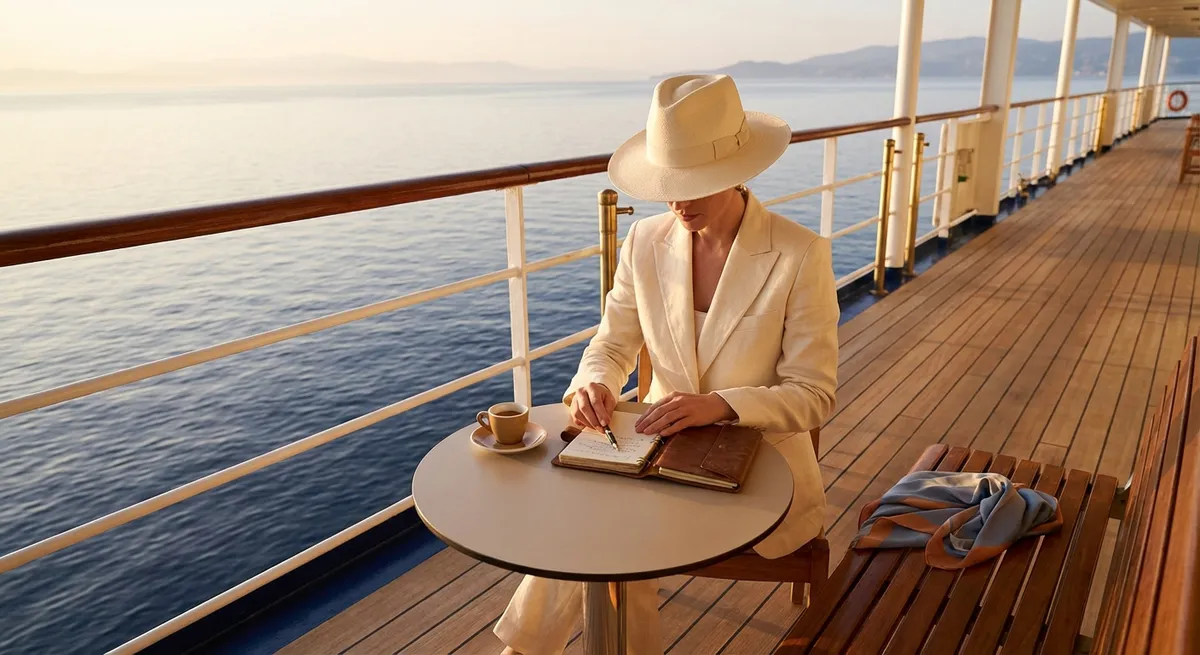
Enhance the sensory environment thoughtfully. If your cruise line permits, pack a small, travel-sized room spray or solid perfume in a subtle, sophisticated scent—think woody, amber, or light citrus—to create a consistent personal fragrance profile throughout the voyage. Use the balcony not just for views, but as part of a daily ritual: an early-morning coffee with a robe and notebook, or a private pre-dinner aperitif as the ship departs port. The goal is not excess; it is continuity and coherence, turning a standard cabin into an exquisitely personal refuge.
Intelligent Port Days: Inverting the Usual Shore Experience
On many itineraries, port days can feel frenetic: early starts, crowded attractions, and rushed returns. Seasoned cruisers invert this pattern, seeking depth over breadth and solace over spectacle.
First, question whether every port demands a full-day, structured excursion. In well-connected cities, traveling independently—using official tourist offices, curated walking routes, or reputable local guides—can provide richer, quieter experiences. Consider exploring a single neighborhood in depth rather than checking off multiple landmarks. A leisurely lunch at a local restaurant where business travelers, not tourists, dine can be more memorable than a hurried photo stop.
Timing is once again a powerful tool. If your ship stays late, disembark mid-morning after the initial rush, or return to the ship in the early afternoon for a restorative interlude by the pool or in a lounge—then step out again in the late afternoon or early evening if local conditions and docking times allow. You’ll experience the port at a more relaxed pace and return on board feeling refreshed rather than depleted. Over the course of a journey, this considered approach keeps your energy and curiosity calibrated rather than exhausted.
Crafting a Personal Evening Ritual Beyond the Show
Evenings at sea tend to funnel guests toward a familiar progression: early or late dinner, a main-stage show, then a crowded bar or lounge. For travelers seeking a more elevated cadence, the evening can become a carefully crafted ritual instead of a routine.
Begin by deciding what you want your evenings to feel like: cinematic, contemplative, social, or restorative. If you value quiet glamour, dine slightly earlier, then choose a low-lit lounge with live jazz or a string trio instead of the main production show. If you relish reflective solitude, take a walk on the open deck after dinner, when the crowds have settled indoors, and let the sound of the wake and night air replace staged entertainment.
You can also layer experiences deliberately. Perhaps you start with a classic cocktail in an elegant bar before dinner, move to a long, unhurried meal, and finish with a nightcap on your balcony under the stars. Or you may prefer a late dessert and coffee in a nearly empty café while others watch the late show. By defining your own evening arc each day, you transform the ship from a fixed program into a canvas for your preferred style of nightlife—quietly luxurious, deeply personal, and entirely under your control.
Conclusion
The most remarkable cruise experiences rarely announce themselves in grand gestures. They emerge instead from a series of subtle decisions: when you choose to dine, how you occupy the quieter corners of the ship, where you direct your attention ashore, and the rituals you establish behind your stateroom door. These five insights are less about hacking the system and more about harmonizing with it—moving slightly off the main current to discover a calmer, more polished flow.
For those who savor elegance in the details, a voyage at sea becomes not just transportation, but a finely tuned exercise in living well—unhurried, intentional, and beautifully your own.
Sources
- U.S. Department of State – Travel Advisory & Safety Tips – Authoritative guidance on staying informed and safe in international ports of call
- Centers for Disease Control and Prevention – Cruise Ship Travel – Health considerations, preparation tips, and best practices for staying well on cruise vacations
- Cruise Lines International Association (CLIA) – Industry-level insights on cruise operations, passenger safety, and evolving standards at sea
- Port of Barcelona – Cruise Passenger Information – Example of official port guidance on logistics, timing, and efficient movement through major cruise terminals
- Harvard Business Review – The Case for Slowing Down – Explores the benefits of intentional pacing and reflection, concepts that translate directly to a more thoughtful cruise experience
Key Takeaway
The most important thing to remember from this article is that this information can change how you think about Travel Tips.