Luxury cruising has matured beyond chandeliers and champagne pyramids. At the very top end of the market, refinement now lives in subtler gestures: the curve of a suite’s terrace, the quiet choreography of a crew who know you prefer Pu-erh tea at sunrise, the knowledge that your ship can slip into a harbor the big vessels can only anchor outside. For travelers who already know the difference between premium and truly exceptional, the contemporary ultra-luxury cruise is less about spectacle and more about precision.
This is the discreet, highly curated layer of cruising that seasoned connoisseurs seek—and where five particular insights separate a merely impressive voyage from a genuinely memorable one.
The New Measure of Luxury: Space, Silence, and Sightlines
On the world’s most luxurious ships, square footage is no longer the only yardstick. The real currency is how that space is orchestrated for privacy, stillness, and views.
Thoughtful ship design now focuses on “quiet corridors” and tiered decks that naturally disperse guests, allowing you to feel as though you’ve found your own private wing, even at near capacity. Suites are intentionally angled so that balconies do not directly face one another, preserving a feeling of seclusion even when you’re outdoors. The most desirable accommodations often sit on transitional decks—between public and purely residential spaces—shielded from the vibrations and ambient noise of entertainment venues.
Sightlines are meticulously engineered. Floor-to-ceiling glass, softened thresholds between interior and exterior, and subtle elevation changes give higher-tier suites an unbroken horizon, free from lifeboats, overhangs, or intrusive railings. On many of the latest ultra-luxury vessels, even bathrooms are oriented toward the sea, with freestanding tubs positioned to frame the sunset rather than the mirror.
For the practiced cruiser, these details are the difference between “spacious” and genuinely serene: a ship that feels composed rather than crowded.
The Suite Economy: Why Top-Tier Cabins Redefine the Entire Voyage
In the ultra-luxury segment, the suite is less a room category and more a philosophy. The best suites reshape how you move through the ship, what you can access, and how you experience time onboard.
Top accommodations often sit within a “ship-within-a-ship” configuration—private elevators, keycard-only corridors, and exclusive lounges that dramatically reduce the friction of daily life at sea. Butler service in this context is not about ostentation; it is about orchestration. Unpacking while you’re at lunch, drawing a bath as you return from an evening concert, pacing room service so that your course arrives when your private terrace is just dipping into the golden hour.
The suite economy also changes your relationship with dining. On the most refined lines, virtually any dish served onboard can be delivered course-by-course to your suite, beautifully plated, sometimes even by the same waitstaff who know your preferences in the main dining room. Your living room becomes an unadvertised specialty restaurant with an impeccable table for two—and the most coveted views on the ship.
For those accustomed to club-level hotels and private villas, a high-caliber suite at sea offers something uniquely compelling: the privacy of a residence with the range and rhythm of a small, well-run resort.
Culinary Precision at Sea: Beyond “Fine Dining” Labels
Among luxury travelers, the idea of “good food on a ship” is no longer a revelation; it is a baseline expectation. What truly stands out now is culinary precision—the ability to tailor, refine, and anticipate at a near-bespoke level.
On the most exacting lines, menus are built with a deep understanding of supply chains at sea. Chefs craft dishes not only around regional ingredients—Mediterranean olive oils, Norwegian shellfish, Japanese citrus—but also around where the ship will actually be able to source those items at their peak. Seasonal routes inform seasonal menus, and the best culinary programs evolve subtly over the course of a single voyage.
For discerning guests, one of the quietest luxuries is the ship’s ability to maintain consistency in highly specific preferences. A certain intensity of espresso, the exact doneness of your fish, the particular crispness of your breakfast pastry—once known, these details are remembered and replicated across venues. This is where a robust onboard provisioning system and well-drilled crew make themselves felt: it is not dramatic, but it is deeply satisfying.
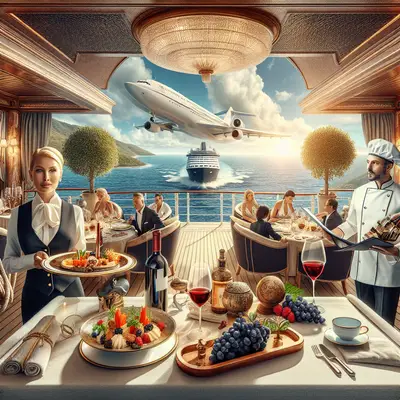
Then there is the unadvertised access that experienced cruisers quietly seek. Private galley tastings with the executive chef. One-off menus built around a wine you’ve brought onboard from a vineyard visit ashore (on lines that permit this). A late-night tasting of reserve cheeses in the quiet of an almost-empty lounge. Luxury in this realm is not about volume or spectacle; it is about calibrated, almost intimate, culinary encounters.
Time as the Ultimate Amenity: Port Strategies for the Experienced Traveler
For the seasoned cruise guest, itineraries are no longer evaluated solely by the names of the ports, but by what those calls actually allow you to do. How many hours in port—and at what time of day—can matter more than the destination itself.
The most sophisticated itineraries are increasingly structured around “high-value time”: very late departures, overnight stays, or pre-dawn arrivals that allow guests to experience cities and coastal towns when they belong to their residents rather than the day-tripper crowd. A midnight sail-away from Venice, a pre-breakfast stroll through a still-sleepy Old Town, or watching Hong Kong’s skyline light up from your balcony before dinner: these are moments that simply do not exist on compressed daylight-only stops.
Smaller ultra-luxury ships gain an additional advantage. Their ability to dock closer to city centers and glide into shallow harbors translates directly into more meaningful hours ashore and less time commuting by tender or coach. For the practiced cruiser, this subtly changes behavior: visits feel less like “operations” and more like extended, unhurried interludes in a place.
More advanced guests also learn to read between the lines of an itinerary: days that look “quiet” on paper—short island calls, scenic cruising through fjords or archipelagos—are often intentional gifts of unscheduled time. These are the days when the ship itself becomes the destination: languid breakfasts, nearly-empty spa facilities, and terraces with only the sound of the sea for company.
Discreet Personalization: The Art of Being Known, Not Displayed
True personalization at the luxury level is measured in subtlety. It is the ability of the ship to recognize you without performing that recognition.
On leading ultra-luxury lines, guest profiles begin long before embarkation. Preferences are gathered quietly—sometimes from previous voyages, sometimes via a few carefully chosen pre-cruise questions. The point is not to create an elaborate dossier, but to understand just enough to remove friction. A particular type of pillow already in place, your preferred sparkling water chilled, the minibar curated rather than stocked to default.
What differentiates the finest operations is how lightly they carry this knowledge. Your name and suite number may be known across multiple venues, but never broadcast. A sommelier might discreetly steer you toward a newly boarded Burgundy because it aligns with your prior choices, without a word about records or notes. Bartenders remember your order but are equally comfortable pretending it is the first time, should the moment or company call for it.
Digital tools increasingly support this, from unobtrusive apps that let you adjust dining times or request in-suite canapés, to behind-the-scenes systems that sync spa, dining, and housekeeping so your day flows without visible coordination. Luxury here is as much about what you do not have to ask for as what you do.
For the experienced cruiser, this creates a rare sensation in travel: feeling consistently seen, yet never put on display.
Conclusion
At the highest levels of cruising, luxury is no longer a matter of overt grandeur. It is the quiet arrangement of space so that you rarely encounter a crowd. It is the way your suite allows you to live at sea as comfortably—and often more beautifully—than in any urban penthouse. It is menus that respond to season and place, itineraries that honor your time ashore, and a crew who navigate your preferences with elegance and restraint.
For cruise enthusiasts who have already sampled the obvious markers of indulgence, these finer calibrations are where the true distinction lies. The ultra-luxury voyage of today is not a performance; it is a composition—of privacy, precision, and a kind of maritime calm that lingers long after the ship has reached its final port.
Sources
- U.S. Federal Maritime Commission – Passenger Vessel Information - Regulatory and structural context for passenger vessel operations and standards
- CLIA (Cruise Lines International Association) – 2023 State of the Cruise Industry - Industry data on capacity, deployment, and evolving guest expectations
- Regent Seven Seas Cruises – The Regent Suite Overview - Example of ultra-luxury suite design and service elements at sea
- Seabourn – Culinary Partnership with Chef Thomas Keller - Illustrates the level of culinary focus and collaboration in the luxury segment
- Harvard Business Review – The Value of Customer Experience, Quantified - Insight into how personalization and seamless service directly shape guest satisfaction and loyalty
Key Takeaway
The most important thing to remember from this article is that this information can change how you think about Luxury Cruises.