There is a particular type of cruiser who moves through a ship with quiet certainty: never rushed, rarely surprised, and always somehow in the right place at the right time. Their advantage is not status alone; it is strategy. For travelers who already understand the basics of cruising, refinement now lies in the subtleties—how you time, tailor, and curate each decision so the voyage feels seamless rather than scheduled. These five exclusive insights are designed for the serious cruise enthusiast who values discretion, precision, and experiences that feel thoughtfully composed rather than mass-produced.
1. Booking with Latitude: Mastering the “Soft Commit” Strategy
Sophisticated cruisers often know that the most important decisions are made long before embarkation. Rather than chasing last-minute deals or locking into the first tempting itinerary, they work with what might be called a “soft commit” strategy: holding carefully chosen sailings early, then refining the details as the voyage approaches.
Begin by identifying two or three itineraries across different lines and cabin categories, ideally 10–14 months in advance. Book the option that aligns best with your preferred ship size, ports, and seasonality—but choose a fare that allows reasonable changes with minimal penalties. Elite travelers then use the intervening months to monitor ship redeployments, refurbishment schedules, and evolving port infrastructure developments, often via cruise line newsrooms and maritime blogs.
This measured flexibility allows upgrades to newly released cabin categories, optimally located suites, or repositioned sailings with superior port times. The result is not simply getting on the right ship, but being in the right stateroom, on the right sailing, under the right conditions—without the stress of frantic, last-minute changes.
2. Curating Cabin Position for True Onboard Serenity
Seasoned guests know that cabin choice is far more nuanced than “inside vs. balcony” or “suite vs. standard.” Placement on the ship profoundly shapes your onboard serenity—especially on longer or port-intensive itineraries where your stateroom becomes a genuine retreat.
Those who value quiet often avoid what might be called “vertical noise corridors”: cabins directly above or below theaters, nightclubs, pool decks, or galleys. Likewise, prime suites near exclusive lounges can be delightful—but only if you understand the traffic patterns during peak cocktail hours or late-night events. A premium approach is to cross-reference deck plans with public area locations, then choose cabins that sit between two decks of accommodations for maximum sound insulation.
For motion sensitivity, midship and lower decks remain the classic guidance, but refined cruisers also factor in itinerary and prevailing seas. North Atlantic crossings, fjord itineraries, and shoulder-season sailings reward ultra-stable placements more than typically calm Caribbean routes. By treating your cabin location as you would a hotel room in a luxury property—thinking about light, noise, footfall, and proximity—you turn an ordinary booking choice into a personal sanctuary at sea.
3. Port Days Reimagined: Inverting the Shore-Excursion Script
For many ships, port days follow a predictable rhythm: mass-disembarkation early, shore-excursion rush, and a mid-afternoon return as guests drift back onboard sun-tired and hurried. Refined cruisers often choose to invert this script, structuring their day to avoid the heaviest flows, and prioritizing depth over breadth.
Rather than defaulting to ship-sponsored excursions, consider a hybrid approach: one or two bespoke, privately arranged experiences across the entire itinerary, paired with intentionally unstructured explorations in ports that reward wandering. Private guides arranged in advance—particularly those specializing in architecture, local gastronomy, or art—can often tailor routes to skip congested tourist clusters in favor of quieter streets, markets, and galleries.
Another advantage of this inverted strategy is timing. In many ports, arriving ashore mid-morning rather than at first light can mean calmer cafés and less crowded museums, especially if several ships are docked simultaneously. Returning to the ship during peak shore-excursion hours, meanwhile, gives you almost private access to the spa, thermal suites, or top-deck lounges. The most discerning cruisers see port days not as breakpoints in the voyage, but as fluid extensions of their own tempo—used thoughtfully to alternate immersion with restoration.
4. Dining as a Design Element, Not a Fixed Schedule
On premium cruises, dining is no longer merely about sustenance; it is a core design element of the journey. Yet even sophisticated guests sometimes over-schedule, treating specialty reservations as boxes to tick rather than moments to orchestrate. An elevated approach treats dining as a narrative that arcs across the voyage, balancing discovery, decadence, and simplicity.
Instead of booking every specialty venue in advance, secure only two or three anchor experiences: for example, the chef’s table on a sea day, a flagship specialty restaurant early in the voyage, and perhaps a more intimate venue paired with a late departure in a culinary-rich port. The remaining nights can be fluid—decided based on mood, weather, and the day’s energy. This allows you to lean into understated elegance some evenings (room service on the balcony, a quiet corner in the main dining room) and indulge in extended, multi-course experiences when you genuinely feel like it.
Discerning diners also learn the unspoken rhythms of the ship. They seek out later seatings on formal or “gala” nights to avoid the early crush, ask for quieter tables slightly removed from high-traffic areas, and coordinate with the sommelier in advance for a curated wine trajectory across the cruise rather than ad-hoc glass selections. Over time, the staff begins to anticipate your preferences, and dining shifts from a series of reservations to a seamless, personalized ritual.
5. Crafting a Personal Atmosphere Onboard: Beyond the Ship’s Design
Luxury ships invest heavily in architecture, lighting, and décor—but the most refined cruisers subtly layer their own atmosphere on top of the ship’s design. They think in terms of sensory cues, daily rituals, and micro-comforts that make any cabin or lounge feel distinctly theirs.
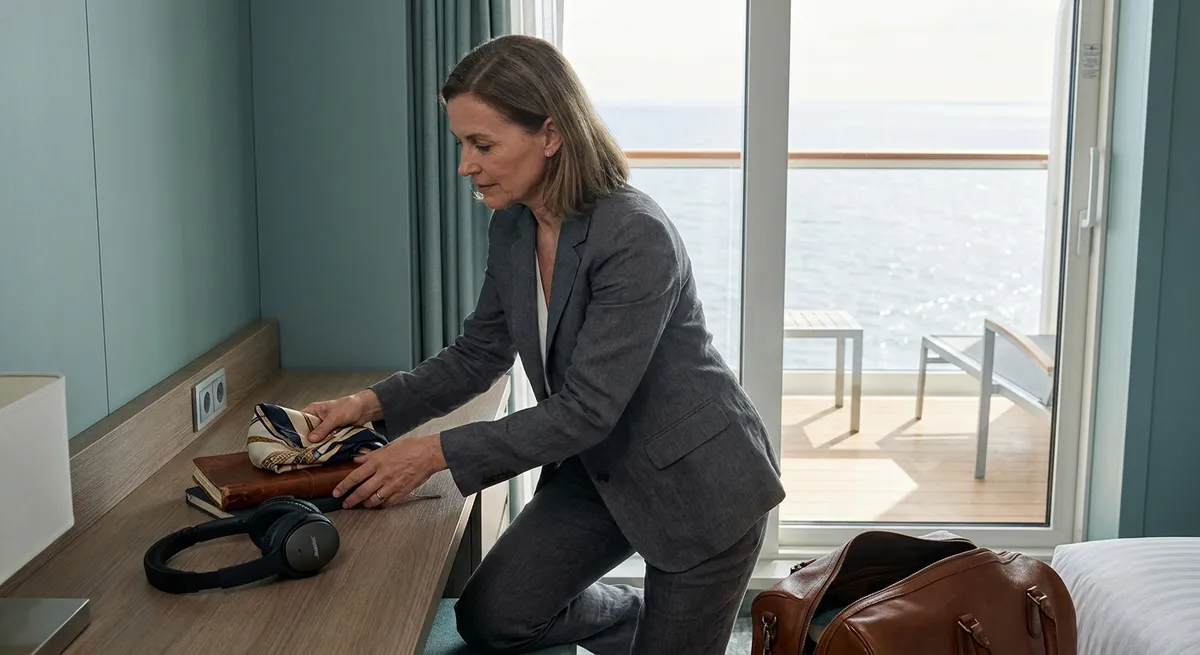
Simple but elevated touches can transform the experience: a small travel candle in a subtle scent (where permitted), a compact Bluetooth speaker for low-volume jazz or classical playlists, a slender leather-bound travel journal, or a cashmere wrap that becomes a constant companion from suite to terrace. These items create continuity—even as ports, climates, and time zones shift—anchoring your sense of place.
Equally important is establishing personal rituals: a quiet early-morning coffee in the same underused lounge, a post-dinner walk on a lesser-known deck, a daily half-hour in the library or observation lounge at a consistent time. Over the course of the cruise, crew members begin to recognize these patterns, leading to anticipatory service—a preferred drink waiting, a favored seat kept subtly available. What begins as a standard sailing gradually takes on the intimacy of a private club at sea.
Conclusion
For experienced cruisers, refinement no longer lies in chasing the newest ship or the largest suite, but in how thoughtfully the voyage is composed. By booking with strategic flexibility, curating cabin placement with intention, inverting the usual port-day routine, treating dining as a flowing narrative, and layering your own atmosphere over the ship’s design, you step beyond generic luxury into something quieter and more personal. The ship remains the same for thousands of guests—but these habits ensure that your version of the journey feels singular, unhurried, and unmistakably your own.
Sources
- [U.S. Department of Transportation – Cruise Ship Travel Tips](https://www.transportation.gov/mission/safety/cruise-ship-travel) – Guidance on safety, planning, and logistics for cruise passengers
- [U.S. Centers for Disease Control and Prevention – Cruise Ship Travel](https://wwwnc.cdc.gov/travel/page/cruise-ship) – Health considerations, preparedness, and recommendations specific to cruise travel
- [CLIA – Cruise Lines International Association](https://cruising.org/en/cruise-101/cruise-planning) – Industry-backed insights on cruise planning, itineraries, and ship selection
- [Consumer Reports – How to Make the Most of a Cruise](https://www.consumerreports.org/travel-cruises/how-to-make-the-most-of-a-cruise-a5456321258/) – Practical advice on cabin choice, excursions, and onboard strategies
- [Travel + Leisure – Cruise Tips From Travel Experts](https://www.travelandleisure.com/trip-ideas/cruises/cruise-tips) – Curated tips from experienced cruisers and travel advisors on elevating the cruise experience
Key Takeaway
The most important thing to remember from this article is that this information can change how you think about Travel Tips.