Every renowned cruise line cultivates a personality as nuanced as a grand hotel or a storied airline. To the uninitiated, ships may appear interchangeable: white hulls, balcony cabins, a pool deck, a theater. Seasoned cruisers know better. The difference between a line that quietly understands your preferences and one that merely meets expectations can define an entire voyage. This is the realm where brand philosophy, ship design, and service culture converge into something far more sophisticated than “floating resorts.”
Below, we explore how leading cruise lines distinguish themselves in subtle but meaningful ways—and share five exclusive insights that discerning enthusiasts use to choose not simply a ship, but a signature at sea.
Beyond “Big vs. Small”: Understanding Brand Architecture
The most refined cruisers don’t start by asking “Which ship is newest?” but “What is this line trying to be?” Cruise companies now manage portfolios of brands that behave more like luxury hotel families than standalone operators. Under the Carnival Corporation umbrella, for example, Carnival Cruise Line, Holland America Line, Princess Cruises, Cunard, and Seabourn occupy carefully defined positions, from festive mainstream to ultra-luxury. Similarly, Royal Caribbean Group stewards Royal Caribbean International, Celebrity Cruises, Silversea, and the expedition-focused brands.
Understanding this architecture is the first step to sophisticated selection. Each line expresses its personality through design language (from dramatic atriums to minimalist suites), onboard rituals (afternoon tea, formal nights, enrichment lectures), and even how it structures time (fixed dining vs. open seating, late-night performances vs. early morning excursions).
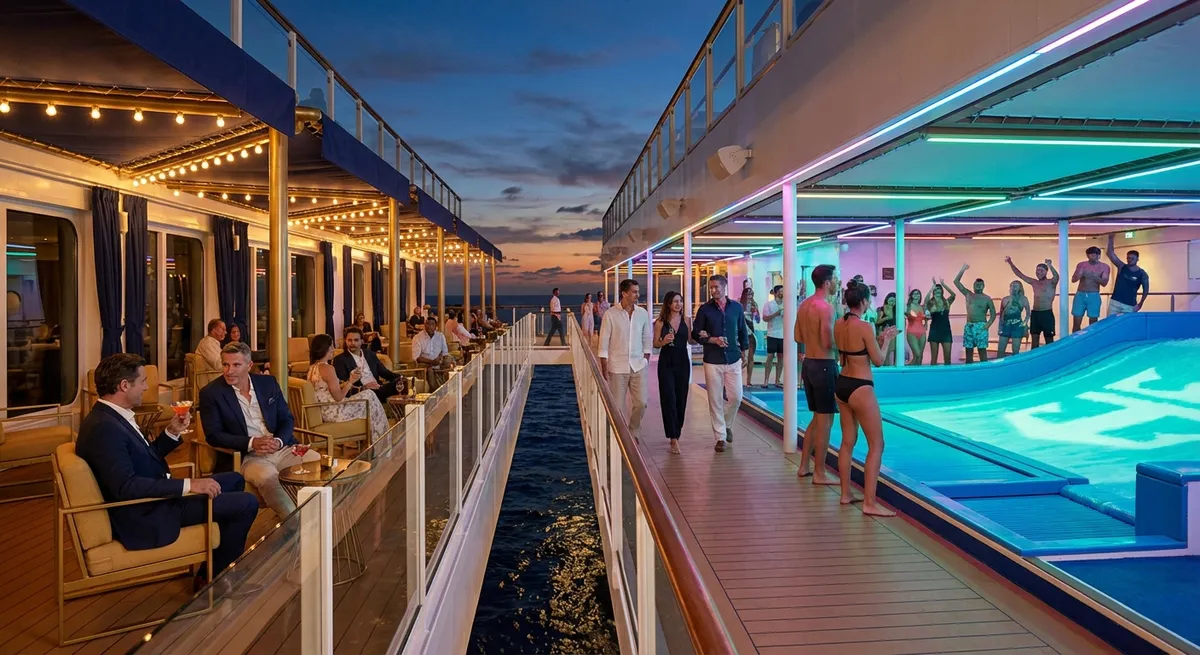
For a guest who values tranquility and contemplative spaces, a line that prides itself on headline-making water slides and zip lines may feel discordant, however impressive the hardware. Conversely, travelers who love a ship that hums late into the night might find quietly elegant libraries and hushed lounges a touch too restrained. When you decode a line’s brand intent—family fun, cultural immersion, grand tradition, wellness focus—you begin matching not just itineraries to your calendar, but identities to your personal style.
How Design Philosophy Signals the Experience You’ll Have
Step onto a ship and you can read the cruise line’s priorities in the first five minutes—if you know what to look for. Some lines design around spectacle: soaring interior promenades, kinetic sculptures, light shows, and high-capacity venues that absorb thousands of guests. Others favor a hotel-like approach, with restrained color palettes, subtle art collections, and discreet circulation corridors that keep public spaces feeling calm even when the ship is full.
Materials are revealing: genuine stone surfaces, tailored textiles, and bespoke furnishings suggest a line that invests deeply in longevity and sensory experience. Lines with a strong design ethos often collaborate with well-known architects or hospitality designers, producing coherent spaces where the stateroom corridors, specialty restaurants, and spa feel like chapters of the same story rather than a patchwork of “themes.”
Even practical design choices encode the experience:
- Elevator and stair placement hints at how much the line expects guests to move between active (pools, sports decks) and contemplative (spa, lounges, library) areas.
- Number and distribution of small venues—jazz clubs, wine bars, cocktail lounges—versus mega-theaters reveals whether the entertainment philosophy is intimate and varied or grand and centralized.
- Outdoor circulation (wraparound promenades, open bow access, tiered aft decks) tells you if the line wants you to engage with the sea itself or primarily with the “resort” onboard.
Discerning cruisers increasingly treat design as a form of curation. They choose lines whose ships function less like amusement parks and more like well-edited lifestyle spaces—where every public room feels intentional rather than merely impressive.
Service Culture: The Invisible Signature of a Cruise Line
Hardware can be photographed; service culture has to be felt. Each cruise line trains its crew to deliver a particular tempo and style of hospitality, from exuberantly friendly to gracefully unobtrusive. Cruise veterans quickly learn that a line’s true “luxury” is often found not in marble and chandeliers, but in how crew members remember preferences, manage crowds, and handle the unexpected.
Some lines emphasize anticipatory service: your espresso appears at breakfast without being requested, turndown is timed to your typical dinner hour, and housekeeping quietly notes whether you prefer more or fewer pillows. Others prize social warmth, where bartenders greet you by name after a single visit, and entertainment staff feel like part of an ongoing house party. Neither is inherently superior; the right choice depends on whether you want to feel gently looked after or delightfully engaged.
This is also where loyalty programs matter. Lines with highly stratified tiers often extend their service culture by layering in pre-arrival concierge outreach, priority embarkation that feels more like a boutique hotel check-in, and discreet access to private lounges or reserved seating in show lounges. For frequent cruisers, these small shifts in friction—never queuing long for tenders, effortlessly securing preferred dining times—can be more valuable than headline perks like free drinks.
When comparing cruise lines, experienced guests look closely at crew-to-guest ratios, but also at crew stability: lines known for long-tenured officers and returning waiters tend to cultivate a deeper, more intuitive service ethos. It’s the difference between hospitality that runs on scripts and hospitality that runs on memory.
Five Exclusive Insights Savvy Cruisers Use When Choosing a Line
Enthusiasts who curate their sailings with intent rely on a set of considerations that rarely appear in glossy brochures. These five insights help distinguish between superficially similar offerings and truly aligned experiences:
The “Second-Tier” Ship Advantage
Flagship, just-launched vessels attract attention—but connoisseurs often gravitate to slightly older sisters within the same class. These ships frequently offer near-identical layouts and amenities, with two crucial advantages: a better-refined onboard operation (after initial quirks have been resolved) and a more relaxed passenger mix. Lines sometimes deploy these ships on more interesting itineraries once the newest vessel takes over marquee routes. As a result, you can experience the brand’s full design language and service philosophy with fewer crowds and more distinctive ports.
Reading Itineraries as Brand Manifestos
The ports a line chooses—and how much time it grants you there—are among the purest expressions of its identity. Lines that excel in cultural depth favor longer days, overnights, and lesser-visited harbors, often supported by expert-led excursions. Lines more focused on the onboard experience cluster itineraries around infrastructure-rich ports that can handle high guest volumes and support frequent shore operations. By comparing a few sample itineraries within the same region across different lines, you can see where each brand sits on the spectrum from “ship as destination” to “ports as primary draw.”
Onboard Atmosphere Through Dining Patterns
Dining structures shape the social architecture of a cruise more than most realize. Lines that emphasize traditional, fixed-seating main dining create a sense of ritual and community: you see the same faces, the same waitstaff, and often form a mini-society for the week. Those that prioritize flexible or “anytime” dining foster a more spontaneous and independent atmosphere, with guests gravitating toward specialty venues and casual spaces on their own schedule. Observing how a line positions its included venues vs. surcharge restaurants, and how difficult reservations are to secure, offers a revealing glimpse into how it expects guests to live onboard.
The Quiet Power of Enrichment Programming
Entertainment is easy to market; true enrichment requires deeper investment. Lines that take lectures, workshops, and destination briefings seriously often align with travelers who value narrative and context—those who want to understand not just where they are, but why it matters. Look beyond headline “celebrity” appearances to the consistency of programming: Is there a coherent thread (culinary, history, art, science, wellness) that defines the brand’s intellectual life at sea? Enthusiasts often choose a line because its enrichment talks, wine tastings, or photography workshops become the highlight of the voyage, rather than an afterthought between shows.
Ship-Within-a-Ship Concepts and Spatial Hierarchies
Several contemporary lines now embed exclusive enclaves—concierge decks, private lounges, restricted-access sun decks—within otherwise large ships. These create a layered experience: you enjoy the breadth of dining and entertainment options available to thousands, but retreat to quieter, curated spaces that feel more like a small luxury vessel. Understanding how each line implements this concept—size of the enclave, ratio of guests to staff, degree of physical separation, and quality of included amenities—allows you to calibrate precisely how much privacy and privilege you want. For many seasoned cruisers, the decision is no longer “mega-ship or small ship,” but “which layered experience aligns with my preferences?”
Matching Your Personal Travel Style to a Line’s DNA
At the highest level, choosing a cruise line is less about abstract categories (“premium,” “luxury,” “contemporary”) and more about alignment of values. Some travelers are energized by a cosmopolitan mix of guests, marquee productions, and innovative onboard attractions; others feel most at home in a refined environment where conversation, cuisine, and unhurried mornings at sea define the cadence.
Ask yourself:
- Do you want your cruise line to function like a resort brand, maximizing activity choice and spectacle, or like a grand hotel, emphasizing atmosphere, culinary craft, and service nuance?
- Are you more intrigued by a line’s hardware innovations (technology, entertainment, family features) or its software (crew training, enrichment depth, itinerary curation)?
- Does your ideal voyage center on intimacy and stillness or variety and buzz?
Once you’ve identified your priorities, studying a line’s design, schedules, enrichment portfolio, and loyalty structure allows you to find a precise brand match. The reward is not only a better cruise, but a sense of continuity: returning to a line whose personality you understand—and which understands you in return—can feel like coming back to a favorite address in a familiar city.
Conclusion
In the current era of sophisticated cruising, ships are no longer interchangeable vessels competing only on size and amenities. Each major line now presents a considered worldview, expressed through design, service, itineraries, and the way guests are invited to inhabit time at sea. For travelers who care about refinement, nuance, and a sense of narrative, these differences are not incidental—they are the experience.
By looking beyond headline features and marketing language, and instead reading cruise lines as complete hospitality brands with distinct DNA, you move from simply booking cabins to curating signatures at sea. The result is not only a more elegant voyage, but a more personally resonant one—where the ship, the service, and the journey feel precisely, and quietly, yours.
Sources
- Cruise Lines International Association (CLIA) – State of the Cruise Industry Outlook - Industry data on growth, passenger trends, and evolving cruise segments
- U.S. Federal Maritime Commission – Passenger Vessel Operator Information - Regulatory and structural information on major cruise operators
- Royal Caribbean Group – Our Brands - Illustrates how a modern cruise conglomerate positions and differentiates its brands
- Carnival Corporation – Our Brands - Overview of brand architecture across multiple segments, from contemporary to ultra-luxury
- Harvard Business Review – “Understanding Customer Experience” - Framework for examining experience design and service culture, relevant to how cruise lines craft their onboard product
Key Takeaway
The most important thing to remember from this article is that this information can change how you think about Cruise Lines.