Luxury cruising has entered a quieter, more considered era—one where refinement is measured less by spectacle and more by nuance. Today’s most rewarding voyages are not defined solely by suites and caviar, but by choreography: how a ship moves, how a crew anticipates, and how a day unfolds with unhurried precision. For the discerning traveler, the real luxury lies in understanding the subtleties that separate a merely expensive sailing from a truly exceptional one.
Below, five exclusive insights reveal what seasoned cruise enthusiasts quietly study long before the first line is cast off—and how those details transform a voyage from pleasant to profound.
1. The Architecture of Space: How Ship Design Shapes Privacy
On a luxury cruise, “crowd management” is not a logistics term—it is a design philosophy. The most refined ships are drawn from the inside out, with guest flow and acoustic privacy as core priorities. Notice how often you can walk from bow to stern without encountering a bottleneck; observe whether a ship offers multiple “micro-environments” rather than one dominant, perpetually busy hub.
High-end vessels increasingly use clever zoning—subtle level changes, curved corridors, and broken sightlines—to create a sense of seclusion even at full occupancy. Balconies may be slightly angled to prevent direct eye contact with neighbors. Lounges are carved into intimate clusters rather than arranged as a single open hall. Even the choice of materials—plush textiles, textured wall coverings, and carpeting versus hard flooring—controls how sound disperses.
Enthusiasts often study deck plans before booking, not only to choose a cabin, but to understand how the ship “breathes.” They look for:
- Multiple, truly distinct pool or relaxation areas
- A forward observation space separate from the main lounge
- A quiet library, bar, or conservatory buffered from through-traffic
- Suite decks shielded from public venues directly above or below
The result is a ship that never feels full, even when every suite is occupied—a luxury you feel, but rarely see promoted in brochures.
2. The Rhythm of the Day: Time as the Ultimate Luxury
While mainstream cruising often follows a loud, clock-driven tempo, upscale lines increasingly design itineraries and onboard programming to respect unstructured time. On the most thoughtfully curated sailings, the daily program reads less like an events calendar and more like a menu of possibilities—no pressure, no fear of missing out.
The distinctions are subtle but profound. Breakfast might be available until late morning in multiple venues, reducing the need to schedule your day around a single sitting. Shore excursions are staggered so that not everyone disembarks at once, and those who stay onboard enjoy a quieter ship by design. Evening entertainment shifts away from singular headline events toward parallel options—an intimate recital, a sommelier-led tasting, a quiet bar with a live pianist—allowing guests to find their own cadence.
Frequent cruisers look for signs that a line understands and protects this rhythm:
- Itineraries with fewer ports but longer calls or overnights
- Sea days deliberately placed to create a natural exhale between marquee destinations
- Flexibility in dining times, spa bookings, and enrichment activities
- Minimal intrusive announcements and a culture that respects calm public spaces
Time that feels both abundant and unhurried is perhaps the rarest commodity in modern travel. When a ship’s schedule is crafted to preserve it, the voyage acquires a different, more restorative character.
3. The Quiet Craft of Service: Anticipation Over Formality
In the world of elevated sea travel, the language of service has shifted. Guests increasingly value intuitive, culturally aware assistance over rigid formality. What distinguishes a truly luxurious experience is not how often you are addressed by name, but how rarely you need to ask for anything twice.
On the finest ships, front-of-house teams are trained not just in etiquette, but in observational awareness. They notice whether you prefer mineral water still or sparkling at lunch. They register if you retreat to the same corner of the lounge at sunset, and ensure that space is available the following evening. They quietly adjust cabin servicing times to your natural routine rather than expecting you to adapt to theirs.
Seasoned cruisers pay close attention to:
- Consistency: Are preferences remembered across venues and days, without prompts?
- Discretion: Are interactions warm and genuine, yet never intrusive?
- Cultural fluency: Does the crew move comfortably between diverse guest expectations and customs?
- Problem-solving: How are minor issues addressed—and do they lead to lasting, thoughtful adjustments?
The apex of cruise service is not about constant attention; it is about the feeling that the ship is gently aligning itself around your habits, without spectacle or ceremony.
4. Culinary Latitude: Beyond “Fine Dining at Sea”
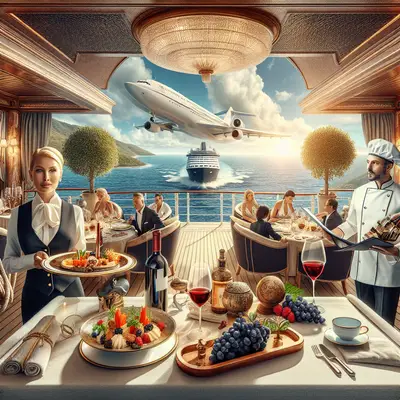
Modern luxury ships increasingly act as floating culinary laboratories, but the true aficionado looks beyond headline names and plated theatrics. The most memorable dining at sea arises from a blend of flexibility, terroir-driven thinking, and a willingness to adapt to place rather than impose a rigid concept.
Refined lines now collaborate directly with regional suppliers, bringing aboard local specialties mid-itinerary—Mediterranean olive oils and seafood in one region, artisanal cheeses or seasonal produce in another. Menus evolve subtly during a voyage, reflecting what was freshest at the last port of call. Wine lists are curated not only for breadth, but for thoughtful pairings with the specific dishes offered that evening.
Enthusiasts look for several quiet signals of serious culinary intent:
- Menus that change meaningfully across the voyage, not just rotating the same core dishes
- A dedicated culinary or wine team visible and accessible to guests, hosting intimate tastings or pairing dinners
- Thoughtful vegetarian and wellness-forward options that feel curated, not obligatory
- A balance of ceremony (tasting menus, chef’s tables) and comfort (elegant, unhurried al fresco lunches, in-suite dining that rivals the restaurants)
The luxury is not just in what is served, but in how willing the culinary team is to tailor the experience—perhaps recreating a dish you loved earlier in the cruise, or pairing a favorite bottle with an off-menu request. That agile responsiveness is what transforms “dining on a ship” into “dining in a well-run, sea-borne restaurant collection.”
5. Meaningful Itineraries: When the Route Becomes the Signature
In the past, luxury at sea was often expressed primarily through hardware: grand atriums, sprawling suites, elaborate spas. Increasingly, the connoisseur’s attention is turning to software—the thought behind the itinerary itself. It is no longer enough for a route to be simply “scenic” or “popular”; the most valuable voyages are intelligently sequenced narratives.
Look, for instance, at sailings that connect lesser-visited ports with marquee destinations in a way that makes thematic sense—pairing gastronomic capitals with emerging wine regions, or combining UNESCO World Heritage cities with smaller towns that reveal the same cultural thread from a different angle. Overnight stays in key ports allow guests to experience a city’s evening rituals—opera, late dinners, waterfront promenades—rather than compressing everything into daylight hours.
Experienced cruisers evaluate itineraries with questions such as:
- Does the route avoid unnecessary repetition of mass-market ports when more refined alternatives exist nearby?
- Are there extended or overnight stays in cities that reward deeper exploration?
- Does the seasonality of the sailing align with the strengths of the region (climate, festivals, wildlife, culinary harvests)?
- How does the line integrate shore experiences—small-group tours, private guides, after-hours access—to complement the onboard standard of luxury?
When the itinerary is treated as a curated sequence rather than a checklist, the ship becomes more than accommodation between stops; it becomes the thread that elegantly stitches distinct places into one coherent journey.
Conclusion
Today’s most sophisticated luxury cruises are defined less by overt opulence and more by an almost architectural attention to detail—how space is arranged, time is honored, service is delivered, cuisine is contextualized, and routes are composed. For the enthusiast, understanding these unspoken codes is itself part of the pleasure, transforming the process of choosing a voyage into a quiet, highly personal art form.
In the end, the most successful sailings share a common quality: they feel as though they were designed with you, not simply for you. When a ship’s every element—seen and unseen—conspires to create that impression, you are not merely taking a cruise. You are inhabiting, for a brief stretch of ocean, a private world in motion.
Sources
- Cruise Lines International Association (CLIA) – 2024 State of the Cruise Industry - Industry overview with insights into trends in luxury, itinerary design, and guest preferences
- U.S. Department of Transportation – Cruise Ship Travel - Government guidance and contextual information on cruise operations and passenger considerations
- Condé Nast Traveler – The Best Cruise Lines in the World: 2023 Readers’ Choice Awards - Editorial perspective on leading luxury and premium cruise lines, including service and design notes
- Forbes – How Luxury Cruising Is Evolving - Discussion of modern luxury cruise trends, from shipboard design to changing guest expectations
- Harvard Business Review – The Elements of Good Service - Analysis of service design and anticipation that underpins the elevated hospitality standards found on luxury ships
Key Takeaway
The most important thing to remember from this article is that this information can change how you think about Luxury Cruises.