There are cities that welcome you politely at the airport—and then there are cities that only truly reveal themselves when you arrive by sea. For the discerning cruiser, the distinction is profound. The harbor line, the orchestration of lights along the waterfront, the hushed choreography of tugs and pilot boats: these are not incidental details, but the prologue to a very specific kind of journey. When you approach a destination by ship, you are granted a vantage point that land travelers never fully experience—one that rearranges scale, rhythm, and even your sense of time.
This is an exploration of destinations whose deepest character emerges in conversation with the sea, and of the subtle, often unspoken advantages available to those who approach them by ship. Woven through are five exclusive insights—small, strategic shifts in how you choose, time, and navigate these cities—that can quietly elevate your next itinerary from pleasant to exceptional.
The Harbor as Prologue: Cities That Stage Their Own Arrival
Every major city has an entrance; only a few have a true maritime overture. Consider how dramatically different a destination feels when you watch it assemble itself on the horizon: minarets arranged against first light, zigzagging ferries crossing your wake, cranes standing sentry above container terminals. The skyline becomes an unfolding narrative rather than a static postcard.
Some harbors are inherently theatrical. Sailing into Hong Kong at dawn, for example, transforms Victoria Harbour from a photographed icon into a living stage: Star Ferries tracing precise diagonals, sampans slipping between barges, and the vertical choreography of glass towers catching the first silver of the day. Approaching Sydney places you within a moving frame: the Opera House unfurling in slow perspective, the Harbour Bridge shifting from distant silhouette to architectural monument.
What elevates this moment for cruise enthusiasts is not simply the view, but the choreography around it. The pilot boat drawing alongside at the breakwater, the subtle reduction of speed, the turn into the wind: these are the small formalities that signal you are not just “arriving somewhere” but being admitted into a city’s maritime salon. For those who pay attention, the harbor arrival becomes an index of the destination’s soul—efficient and hushed, or flamboyant and theatrical, or quietly practical.
Exclusive Insight #1: Curate Your Cabin for the Approach, Not Just the View
When choosing accommodation, seasoned cruisers often default to “port vs. starboard” and “forward vs. aft” without considering the choreography of arrival. In cities where the harbor entrance is a processional—Sydney, Vancouver, Istanbul—selecting a cabin based on the pilotage route and expected turning basin can be transformative.
Consult satellite imagery of the harbor and note docking positions and approach channels. In some ports, the most dramatic views occur as the ship turns 180 degrees to back into a berth; in others, the landmark skyline remains consistently on one side. Aligning your cabin with this choreography yields a more cinematic experience of the destination’s reveal than any generic “sea view” could promise.
Tidal Timekeeping: Destinations That Change With the Clock
Some coastal cities are defined as much by their tidal rhythm as by their architecture. Saint-Malo’s ramparts feel entirely different at high tide, when the sea presses luxuriously against stone, compared with low tide, when vast expanses of seabed appear like a temporary annex to the city. In places like Amsterdam, Hamburg, or Copenhagen, the character of waterfront districts subtly shifts across the day: morning deliveries by boat, midday commuter ferries, evening barge traffic edged in amber light.
Arriving by cruise ship gives you a rare advantage in this temporal choreography: you are already on the water as the city transitions through its most revealing phases. The first café lights on the quay, the retreat of day-trip ferries, the moment when working harbors exhale and pleasure craft take over—all of this is most legible from your elevated vantage point.
This temporal awareness can help you reframe your shore days. Rather than treating port calls as blocks of “available time,” consider them as arcs that intersect with the city’s own maritime schedule: markets that only face the waterfront early, harborside neighborhoods that take on a different texture after commuter traffic subsides, or waterfront museums that are best appreciated as the light shifts across their façades.
Exclusive Insight #2: Use Marine Traffic Data to Decode a City’s Rhythm
Publicly available marine tracking sites—originally designed for commercial and safety purposes—have become a quiet tool for sophisticated cruise planning. Before visiting a destination, study a typical day’s vessel movements in its harbor. Note peak inbound and outbound ferry times, cargo operations, and local tour-boat patterns.
This data reveals when certain quays are bustling versus tranquil, when harborfront cafés are framed by passing sailboats rather than delivery barges, and when smaller inlets are undisturbed enough for contemplative walks or waterside dining. Aligning your onshore schedule with these shifts allows you to experience the waterfront as a local rhythm rather than a static backdrop.
The Hidden Second City: Waterfront Districts Beyond the Terminal
For many travelers, “the port” is simply the pier where the ship docks. For the more attentive cruiser, the port is often an entirely separate city layered within the city—part working infrastructure, part cultural memory. In Hamburg, the Landungsbrücken and Speicherstadt are not merely attractive waterfront zones, but living evidence of the city’s intimate dialogue with maritime trade. In Marseille, the Vieux-Port is not a quaint postcard, but the historic heart from which the city’s identity radiates.
Cruise terminals are usually positioned where commerce and space allow, not necessarily where the city’s maritime personality is at its most articulate. This creates an opportunity: step beyond the immediate port complex and seek out the “historic waterline”—the original quay, inner harbor, or tidal basin that once served as the city’s primary maritime interface. Often, this zone is where you’ll find the most nuanced interplay between local life and seafaring heritage: ship chandlers transformed into design studios, former warehouses converted into performance spaces, old ferry piers reborn as cultural promenades.
Exclusive Insight #3: Trace the Old Waterline Before You Explore Ashore
Before your voyage, look up historical maps or city-planning documents that show the harbor as it was 50–100 years ago. Identify where the original waterfront lay before reclamation projects, containerization, and cruise terminals reshaped the shoreline. Then build your shore plan around reconnecting with that earlier waterline.
In cities like Barcelona, Trieste, or Antwerp, walking the “ghost edge” of the former harbor yields a richer understanding of the destination’s commercial, cultural, and even culinary evolution. You begin to see how the city once faced the sea—and how it has chosen to turn, embrace, or retreat from it over time. This awareness subtly differentiates your experience from that of the casual visitor who never ventures beyond terminal and town square.
The Privileged Horizon: Coastal Landscapes Framing Urban Destinations
Some ports operate as gateways to natural panoramas whose scale is only fully legible from the ocean. Sailing into Vancouver or Cape Town, the surrounding ranges and headlands reposition the city as a counterpoint, not the main event. In the Norwegian fjords, the settlements themselves feel like punctuation marks in a narrative written by cliffs, waterfalls, and light.
The sophisticated cruiser learns to read these landscapes as part of the destination rather than mere approach scenery. The geometry of headlands, the alignment of islands, the way light moves across ridgelines at different times of day—all of these shape the mood into which you arrive. In many cases, that broad maritime perspective will alter how you then navigate the city on foot: which viewpoints you seek, which coastal paths you prioritize, which neighborhoods you intuitively understand as sheltered, exposed, or transitional.
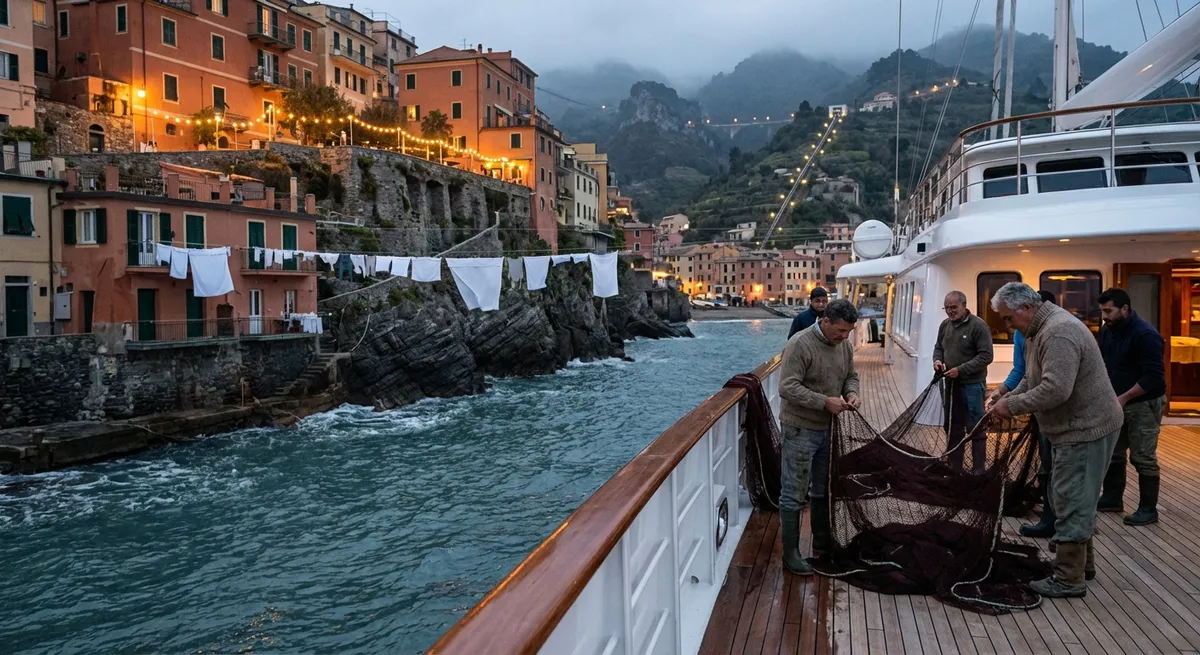
Even in more modest harbors, such as those along the Dalmatian Coast or within Greece’s island chains, the relationship between town, bay, and surrounding terrain becomes a quiet key to unlocking local life. Fishing communities, for example, often cluster where the harbor provides not just convenience but a specific shelter from prevailing winds—details that become immediately visible from a ship’s vantage point.
Exclusive Insight #4: Photograph the Approach as a Map for Your Time Ashore
Rather than treating your arrival photographs as mere souvenirs, use them as a functional layer of cartography. Capture wide, high-resolution shots of the harbor, coastline, and city from the ship’s rail as you approach and, if possible, as you depart. Zoom in on subtle details: a staircase cut into a cliffside, a cluster of terracotta roofs on an unexpected headland, a solitary bell tower that seems farther from the central waterfront.
Later, onshore, revisit these images and cross-reference them with a map. You’ll often discover intriguing vantage points, under-the-radar neighborhoods, or coastal paths you might have overlooked in traditional guidebooks. This “aerial” reconnaissance—albeit from sea level—allows you to curate a day ashore guided by your own visual curiosity rather than by standard tourist circuits.
Quiet Access: Micro-Privileges Only the Sea Confers
Beyond the drama of arrival and the allure of waterfront districts, there is a subtler set of privileges available only to those who approach destinations by sea. Some are logistical: the ability to disembark near historic cores where roads would otherwise deliver you to outlying transport hubs; the ease of visiting multiple coastal towns in a single itinerary without changing hotels or navigating unfamiliar rail systems.
Others are almost psychological. There is a composure that comes from entering a city without the friction of traffic, ticketing, or transit fatigue—a different mindset with which to receive a place. You are likely to step ashore rested, observant, and slightly ahead of the day’s rhythms rather than jostled into them. In destinations where daytime visitor numbers can swell dramatically, this head start becomes a quiet advantage: early access to waterfront galleries, unhurried coffee at harbor cafés, or a tranquil wander through morning markets before commuter and excursion traffic converges.
For those who appreciate refinement, another underappreciated privilege is the option to retreat gracefully. Knowing that, after an intense immersion in a city’s energy, you can return to the ship—to a familiar, well-ordered environment with attentive service and a curated evening ahead—changes how boldly you might explore ashore.
Exclusive Insight #5: Design “Harbor-First” Days, Not “Port-First” Days
Instead of planning shore time around flagship attractions, build at least one day per voyage around the harbor itself as your primary subject. Start by identifying places where the city’s relationship to the water is most nuanced: ferry crossings used by locals, waterfront libraries or cultural centers, maritime museums integrated into working docks, or bridges whose pedestrian paths offer layered perspectives on river and harbor traffic.
Plan a sequence that begins and ends at the water’s edge: a morning spent crossing the harbor as locals do, midday in a waterside cultural space, an afternoon walk along a lesser-known quay, and a return to the ship timed to watch the shifting light on the water. This harbor-centric lens reframes the city not as a static checklist of sights, but as a living maritime organism—one you are uniquely positioned to understand because you arrived as part of its seaborne traffic, not apart from it.
Conclusion
To travel by cruise ship is, at its most rewarding, to accept the sea as both transport and lens. Coastal cities cease to be mere stops on an itinerary and instead become complex intersections of tide, trade, architecture, and light. From the choreography of harbor arrivals to the rediscovery of historic waterlines, from the framing power of surrounding landscapes to the micro-privileges of maritime access, each destination becomes more legible when read from the water inward.
For cruise enthusiasts, this shift in perspective offers an enduring reward: the sense that you are not simply visiting cities that happen to be on the coast, but engaging with cities that exist because of the coast. With a few deliberate choices—of cabin placement, timing, research, and onshore focus—you can transform each port call into a deeper dialogue between ship and shore, between the city you see and the one that quietly emerges when approached by sea.
Sources
- Port of Sydney – Cruise Information – Official details on cruise berths, approaches, and harbor logistics in Sydney
- Hong Kong Tourism Board – Victoria Harbour – Overview of the harbor’s role in Hong Kong’s identity and visitor experience
- UNESCO – Historic City of Saint-Malo – Historical context on Saint-Malo’s fortified waterfront and maritime heritage
- Port of Vancouver – Cruise Guide – Information on cruise approaches, terminals, and harbor setting in Vancouver
- MarineTraffic – Live Vessel Tracking – Real-time and historical vessel movement data useful for understanding harbor rhythms and planning port days
Key Takeaway
The most important thing to remember from this article is that this information can change how you think about Destinations.