For years, the Northern Lights were the domain of hardy land‑based travelers—those willing to brave polar nights, remote lodges, and endless layers of thermal gear. Now, with Northern Lights photography and travel stories trending globally and dedicated aurora content surging across social media, the world’s gaze has shifted decisively north. Expedition cruise lines have taken note, rapidly refining itineraries through Norway, Iceland, Greenland, and the Far North of Canada to meet a very specific desire: to witness the aurora borealis in absolute comfort, with a flute of Champagne in hand rather than a frozen tripod.
Recently, first‑person reports and guides on “the best places and times to see the Northern Lights” have gone viral, dovetailing with a surge of bookings on lines such as Hurtigruten, Ponant, Viking, Silversea, and Seabourn for aurora‑focused sailings. For discerning travelers, this isn’t just another bucket‑list check. It’s a chance to pair a once‑in‑a‑lifetime celestial display with a new kind of slow, cinematic Arctic voyage—where design, gastronomy, and science converge north of the Arctic Circle.
Below are five refined, insider perspectives on the Northern Lights that are reshaping how sophisticated cruisers are experiencing the high latitudes right now.
The New Arctic Grand Tour: Following the Science, Not the Stereotypes
Traditionally, “Northern Lights season” was casually defined as “go in winter and hope for the best.” Today’s aurora‑chasing cruises are far more precise, increasingly guided by real‑time solar data and long‑range forecasts from agencies like NOAA’s Space Weather Prediction Center. Lines such as Hurtigruten (now HX) and Viking are structuring itineraries around peak auroral months—typically late September through early April—while integrating flexibility for cloud cover and geomagnetic activity.
A sophisticated trend emerging this season: itineraries that arc across multiple auroral zones instead of anchoring to a single port. Think Tromsø to Alta to the North Cape and onward to Svalbard, or Reykjavik to the remote Westfjords, with late‑night repositioning to outrun coastal cloud bands. On ultra‑luxury expedition ships like Seabourn Venture or Silversea’s Silver Endeavour, bridge teams work hand‑in‑hand with onboard astronomers, repositioning the vessel into clearer skies at short notice. For guests, this means the “grand tour” of the auroral oval is no longer an abstract concept—it’s baked into the voyage design, traded not in hopes but in probabilities, discreetly communicated each evening alongside the next day’s menu.
Elevating the Viewing Ritual: From Windswept Decks to Curated Sky Salons
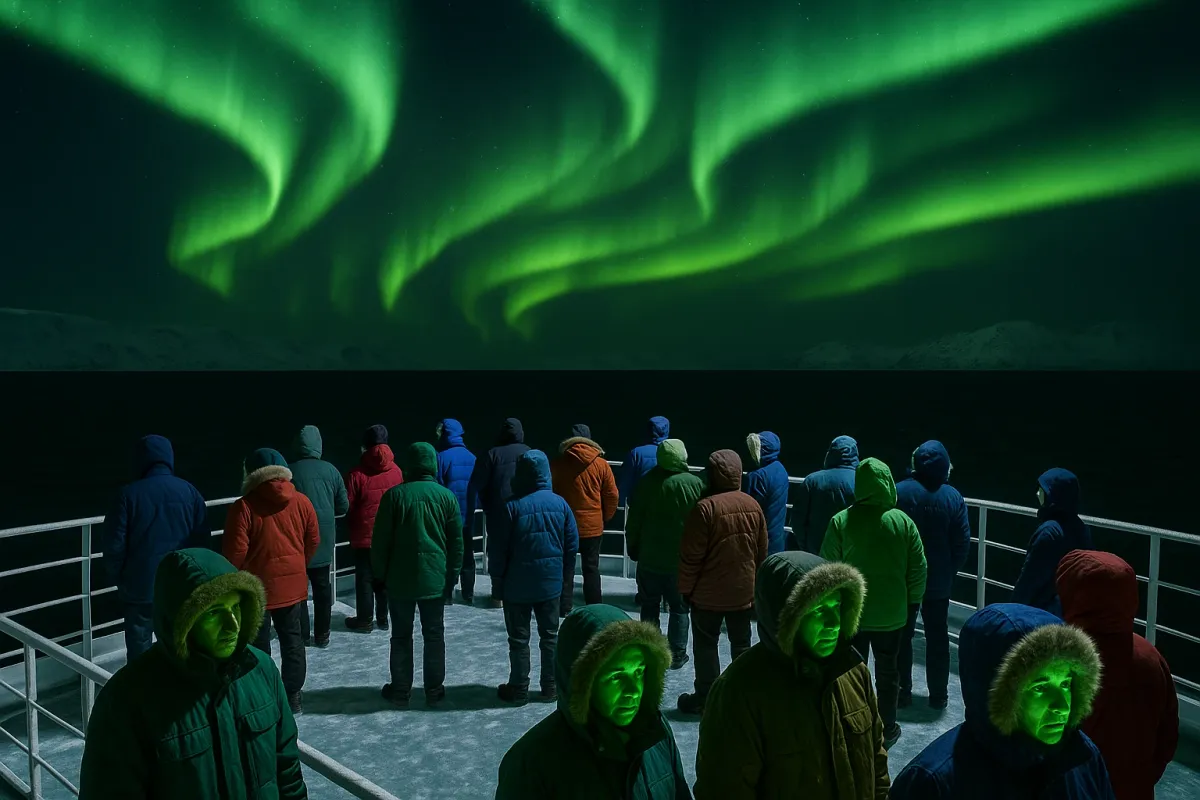
If early aurora cruises were about stoic perseverance on an icy observation deck, this new wave is about ritualized, elevated viewing. Many expedition vessels launched in the last five years—think Ponant’s Le Commandant Charcot, Viking’s ocean ships, or HX’s upgraded coastal fleet—have refined outdoor and indoor spaces explicitly with aurora in mind, responding to guest feedback and the social media demand for “the perfect Northern Lights setting.”
Expect heated outdoor observation terraces, wind‑protected loungers with fur throws, and discreet floor‑level lighting designed to preserve night vision. Indoors, dedicated “sky salons” and panoramic lounges dim all non‑essential lighting during high auroral activity, turning the entire space into a darkroom for the heavens. On some sailings, the maître d’ trims wine service to favor elegant stemware that minimizes glare and reflection, while bartenders curate Northern Lights–inspired cocktails with subtle luminance—evocative, but never bright enough to spoil the view. It’s not simply stargazing; it’s a curated nocturnal experience where architecture, gastronomy, and astronomy interlock.
Beyond the Spectacle: Onboard Science Programs That Match the Skies
One of the most compelling shifts this season is the growing seriousness of the science onboard. With solar activity on an upswing in the current cycle, cruise lines are leveraging heightened auroral seasons to introduce deeper educational programs that go far beyond “fun facts under the stars.” Collaborations with research institutes in Norway, Iceland, and Canada, as well as visiting lecturers in astrophysics and space weather, are increasingly becoming standard on premium aurora sailings.
For high‑end guests used to private galleries and expert‑led city tours, this scholarly lens feels familiar and welcome. On some itineraries, guests attend pre‑dinner briefings on solar wind and geomagnetic storms, then step out onto deck to see theory made manifest in shimmering green arcs. Expedition teams project real‑time Kp‑index charts and satellite imagery in the lecture theater or even on in‑suite TVs, allowing passengers to understand why the sky is alive on one night and muted the next. The result is a rare blend: a voyage that is at once profoundly romantic and intellectually satisfying—perfectly suited to the Cruise Guide Journal reader who values context as much as spectacle.
Designing the Perfect Arctic Day: Slow Ports, Long Nights, and Culinary Warmth
As aurora tourism has matured, itinerary planners have quietly begun to rebalance the daily rhythm around the night sky. Rather than stacking ports in quick succession, many lines are choosing fewer, deeper calls in destinations like Tromsø, Alta, Kirkenes, and Ísafjörður—ports with strong cultural and culinary anchors that reward slower exploration. Shore time is often front‑loaded into the lighter hours: a Sami reindeer camp in Finnmark, a private tasting of new‑Nordic cuisine in a Reykjavik townhouse, or a husky safari over powder‑soft tundra.
The evenings, by contrast, are intentionally unhurried. Early seatings in the main restaurant, with thoughtfully calibrated tasting menus—root vegetables, Arctic char, reindeer, cloudberries—are designed to conclude before the primary auroral window. Innsbruck‑style late suppers are replaced by refined, late‑night snacks: miniature fish stews, artisanal chocolates, and Norwegian cheeses appearing in lounges once the first streaks of green emerge. The choreography is subtle but deliberate: everything bends around the night sky, ensuring that when the aurora does unfurl, guests are unencumbered by schedules and fully present for the performance.
The New Exclusivity: Smaller Ships, Farther North, Deeper Silence
With Northern Lights images flooding Instagram and TikTok, exclusivity in aurora travel no longer rests on simply “having seen them.” The differentiator now is how and where you experienced them. This is where the latest generation of small expedition vessels and ultra‑luxury yachts have quietly claimed the high ground, operating in remote regions where there are no city halos, no shore crowds, and often no other ships in sight.
Vessels such as Seabourn Pursuit, Silversea’s polar‑class fleet, and Ponant’s ice‑strengthened ships are venturing deeper into fjords, edging alongside silent glaciers, and—during shoulder seasons—reaching high‑latitude settlements that feel worlds away from conventional tourism. Standing on a low‑lit forward deck in a fjord near Alta, with snow‑drifted cliffs rising on both sides and the ship’s engines humming at barely a whisper, the aurora feels not like a performance for the masses but a private commission. For the seasoned cruiser who has “done” the Caribbean and Mediterranean, this measured solitude—backed by Michelin‑level cuisine, sumptuous suites, and almost impossibly attentive service—is becoming the new benchmark of luxury.
Conclusion
As first‑hand Northern Lights stories ripple across social media and aurora photography continues to enchant global audiences, cruise lines have responded with a more nuanced, more elevated take on Arctic voyaging. They are fine‑tuning itineraries with scientific precision, designing spaces that honor the dark, deepening onboard scholarship, and orchestrating each day so that the night sky can take center stage. Most importantly, they are reclaiming a sense of rarity in a phenomenon that is, paradoxically, more visible online than ever before.
For the discerning traveler, the Northern Lights are no longer a gamble whispered about in snowy car parks; they are the luminous centerpiece of a carefully composed journey. In this new era of Arctic cruising, the true luxury isn’t simply seeing the sky ignite—it’s the quiet certainty that when it does, you will be in exactly the right place, in precisely the right company, with nothing between you and the dancing heavens but a pane of polar air.
Key Takeaway
The most important thing to remember from this article is that this information can change how you think about Destinations.