In an online world obsessed with flash sales, viral memes, and Cyber Monday countdown clocks, the true definition of luxury is quietly shifting. While mass‑market travel clamors for attention with doorbuster deals and “limited‑time offers,” the ultra‑luxury cruise sector is moving in the opposite direction—toward discretion, curation, and depth. For discerning travelers, the most coveted experiences at sea are no longer about being seen; they are about being exquisitely understood.
This season, as digital commerce reaches a fever pitch and travelers chase savings in a thousand browser tabs, luxury cruise lines such as Regent Seven Seas Cruises, Seabourn, Silversea, Explora Journeys, and The Ritz‑Carlton Yacht Collection are elevating something the internet cannot discount: time, space, and serenity. From yacht‑style vessels that feel more like private clubs than ships, to new expedition hardware sailing to the polar frontiers, 2025’s most sophisticated voyages are defined less by spectacle and more by the quiet precision of how every moment is orchestrated.
Below, Cruise Guide Journal distills five exclusive, insider‑level insights shaping ultra‑luxury cruising right now—details that seasoned connoisseurs are already whispering about, and that first‑time luxury cruisers should know before they book.
The New Benchmark: Private Yacht Aesthetic on Ocean‑Going Vessels
One of the most striking evolutions of the moment is aesthetic rather than technological: ultra‑luxury ships are increasingly designed to feel like privately owned superyachts. Explora Journeys’ EXPLORA I and EXPLORA II, The Ritz‑Carlton Yacht Collection’s Evrima and Ilma, and Seabourn’s new generation vessels all share a common design language—low passenger counts, expansive outdoor decks, residential‑style interiors, and a deliberate escape from the “ship‑like” feel. Public spaces are no longer grand atriums shouting for attention; they are more akin to a well‑curated members’ club, with muted palettes, custom art, and residential furnishings.
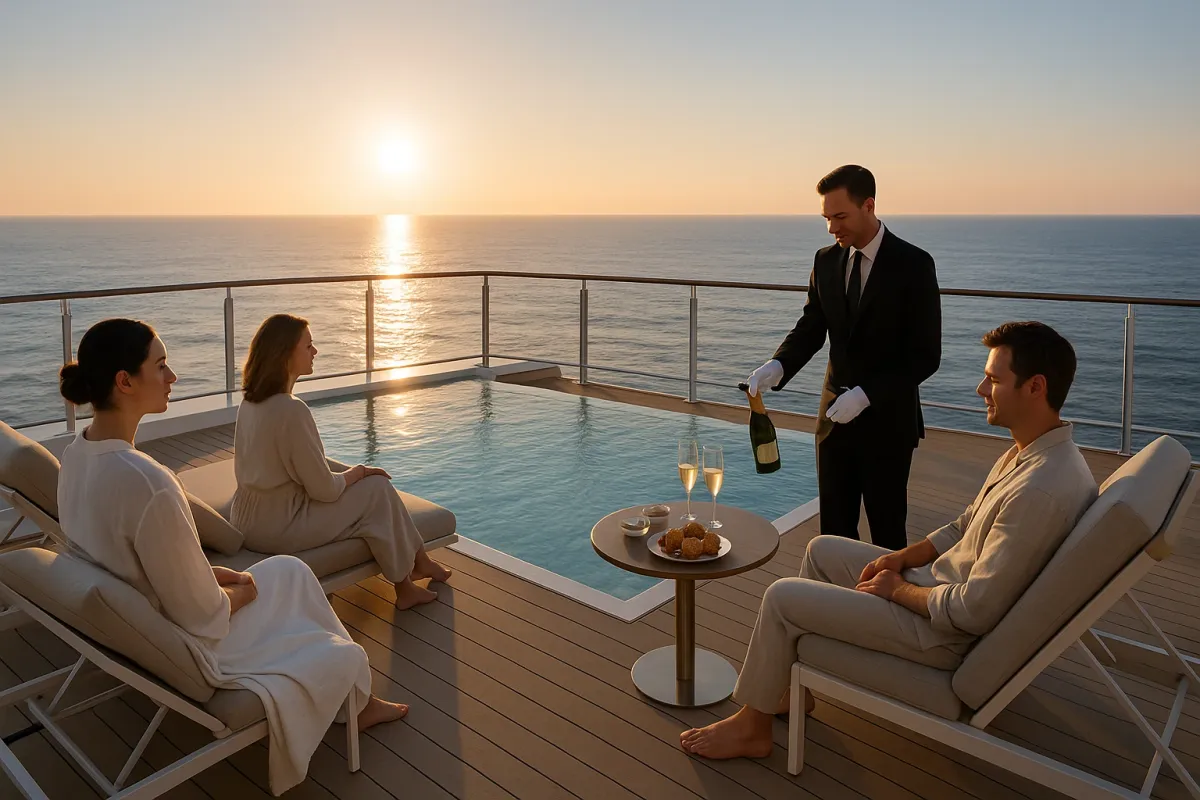
For guests, this shift rewrites the social experience on board. Instead of navigating crowded promenades and large theaters, you drift between lounges and observation bars that invite lingering conversations and unhurried Champagne tastings. The true luxury is spatial: more square footage per passenger, more terraces and cabanas, more places to be alone without ever feeling isolated. Travelers in 2025 are increasingly choosing these yacht‑style ships because they offer something no Cyber Monday promotion can match: the feeling that the vessel itself could, plausibly, be yours.
Intimacy of the Itinerary: Longer Calls, Fewer Ports, Deeper Stories
As mass‑market lines compete on the number of ports squeezed into a week, ultra‑luxury brands are quietly curating the opposite: slower, more thoughtful itineraries with longer stays and overnight calls. Regent Seven Seas Cruises, often cited for operating some of the world’s most luxurious ships, has leaned into this trend with extended overnights in cities such as Monte Carlo, Lisbon, and Tokyo, allowing guests to experience destinations in evening attire rather than excursion lanyards.
This is partly a reaction to a broader travel mood. After years of compressed, checklist tourism, many affluent travelers are choosing depth over breadth. Luxury lines now partner with local experts—Michelin‑recognized chefs, art historians, marine biologists—to turn a single port day into a miniature residency. On Seabourn’s expedition ships, for example, a landing in Antarctica or Greenland is no longer merely a photo stop; it’s framed by briefings, lectures, and post‑excursion salons that transform a day on the ice into part of a larger, narrative arc.
The insider play in 2025 is to look not just at where a ship goes, but how long it lingers. A seemingly modest itinerary with four ports in ten days may, in practice, deliver a far richer experience than a frenetic “seven ports in seven nights” sprint.
Quiet Personalization: Data‑Light, Human‑Heavy Service
In a connected era dominated by algorithms and targeted offers, the most forward‑thinking luxury cruise lines are practicing a subtler, more human‑centric form of personalization. While big‑ship brands proudly advertise app‑driven experiences and wearable tech, ultra‑luxury operators are increasingly uninterested in turning a voyage into a digital dashboard. Their approach is quieter—and far more refined.
On Silversea, Regent, and The Ritz‑Carlton Yacht Collection, butlers and suite hosts are not simply executing requests; they are observing patterns. Which Champagne you reached for first at sail‑away, how you take your espresso, which side of the ship you prefer at sunset—these details are noted discreetly and acted upon without fanfare. Menus are adjusted mid‑voyage to reflect guests’ preferences. Wellness teams suggest treatments that align with how you are actually spending your days, not based on a pre‑departure survey filed away weeks before.
For those fatigued by constant digital prompts in everyday life, this low‑tech personalization feels almost radical. The luxury is not that someone knows everything about you from your data; it’s that, for a brief window of time, a small team of professionals pays such close attention that you never need to ask twice.
Expedition as the New Pinnacle of Prestige
While mainstream cruising still defines luxury in terms of suite size and brand partnerships, the ultra‑affluent are increasingly measuring prestige in degrees of latitude. With new or recently launched expedition tonnage from Seabourn, Silversea, Viking, and upcoming units from several boutique lines, the world’s most exclusive voyages are now pushing into the polar and sub‑polar regions with a level of comfort once reserved for the Mediterranean in high summer.
The distinction in 2025 is that “expedition” no longer means sacrificing refinement for ruggedness. Ships such as Seabourn Venture and Silver Endeavour pair ice‑class hulls with caviar service, designer suites, and high‑end wellness programs. You might step from a Zodiac landing in Svalbard straight into a tasting menu designed by a Michelin‑starred chef. Increasingly, the true bragging rights among sophisticated cruisers are not about having sailed the Caribbean in a top suite—it’s about having crossed the Antarctic Circle or explored remote fjords in Chile, all without ever compromising on linen thread count.
Travel advisors who specialize in ultra‑luxury are noting a marked pivot: affluent guests who have “done” the big suites on mass‑market megaships are now inquiring about Greenland, the Northwest Passage, or the Ross Sea. The prestige lies not in the logo stitched onto your bathrobe, but in the coordinates stamped into your logbook.
Sustainability as a Marker of Taste, Not Just Ethics
As climate conversations intensify and regulation tightens, sustainability has become far more than a marketing footnote—it is emerging as a quiet but decisive marker of taste among luxury cruisers. Guests who invest in high‑end travel are now asking pointed questions: Is this ship running on LNG or conventional fuel? How is waste processed? What partnerships exist with local communities? The answers, increasingly, influence booking decisions.
In response, leading luxury lines are investing heavily in cleaner propulsion, advanced wastewater treatment, and reduced‑impact shore programming. Some are limiting passenger numbers in sensitive regions, even when demand is high; others are rethinking onboard boutiques and amenities around durability and provenance rather than volume. The most sophisticated guests no longer equate luxury with excess; they are looking for considered abundance—fewer, better things, experienced more thoughtfully and with a lighter footprint.
On social media, this shift is subtle but visible. The most resonant images from luxury voyages are no longer just tables groaning under towers of lobster and champagne. Instead, they are candid shots of silent decks under the aurora, a single kayak in a vast fjord, or a chef plating locally sourced ingredients in a dining room that feels more like a private residence than a restaurant at sea. The message: Luxury is not about how loudly you consume, but how quietly you belong.
Conclusion
In a season dominated by sales banners and viral distractions, ultra‑luxury cruising is charting a more measured course—one defined by discretion, slowness, and intent. Yacht‑style design, deeper itineraries, human‑centered personalization, prestige expeditions, and meaningful sustainability are collectively redrawing the boundaries of what it means to sail well.
For those attuned to these nuances, choosing a voyage in 2025 becomes less about price‑per‑night and more about alignment—of values, of tempo, and of sensibility. The finest ships afloat are no longer simply places to sleep between ports; they are floating worlds, meticulously crafted for travelers who understand that true luxury isn’t about having everything. It’s about having precisely what you need, exactly when—and where—you most desire it.
Key Takeaway
The most important thing to remember from this article is that this information can change how you think about Luxury Cruises.