Luxury at sea is rarely about the obvious. For the cultivated cruiser, the true distinction between today’s leading cruise lines lives in the almost-invisible decisions: how a line curates silence, designs a chair for lingering conversation, sources a tomato, or orchestrates a tender ride in a remote anchorage. This is where brands move beyond marketing language and reveal who they really are.
This guide steps past the brochure gloss to explore how different cruise lines actually feel once you are aboard—and offers five exclusive, nuanced insights that seasoned cruise enthusiasts tend to recognize instantly, but rarely put into words.
Reading a Cruise Line’s “Signature World”
Every major cruise line has a visible identity—logo, color palette, taglines—but its signature world is defined by how it wants you to move, interact, and spend time on board. The best way to read that world is to watch what happens in the “in-between” spaces: corridors, lounges between peak hours, tender platforms, even stairwells.
On heritage-focused lines such as Cunard, the ship’s architecture and rituals (afternoon tea with live piano, white-glove service, dedicated ballroom spaces) reinforce a narrative of grand, ocean-liner tradition. In contrast, experience-forward lines like Royal Caribbean and Norwegian design circulation to bring you repeatedly past active zones—ice rinks, skydiving simulators, expansive pool decks—subtly placing spectacle at the center of the day.
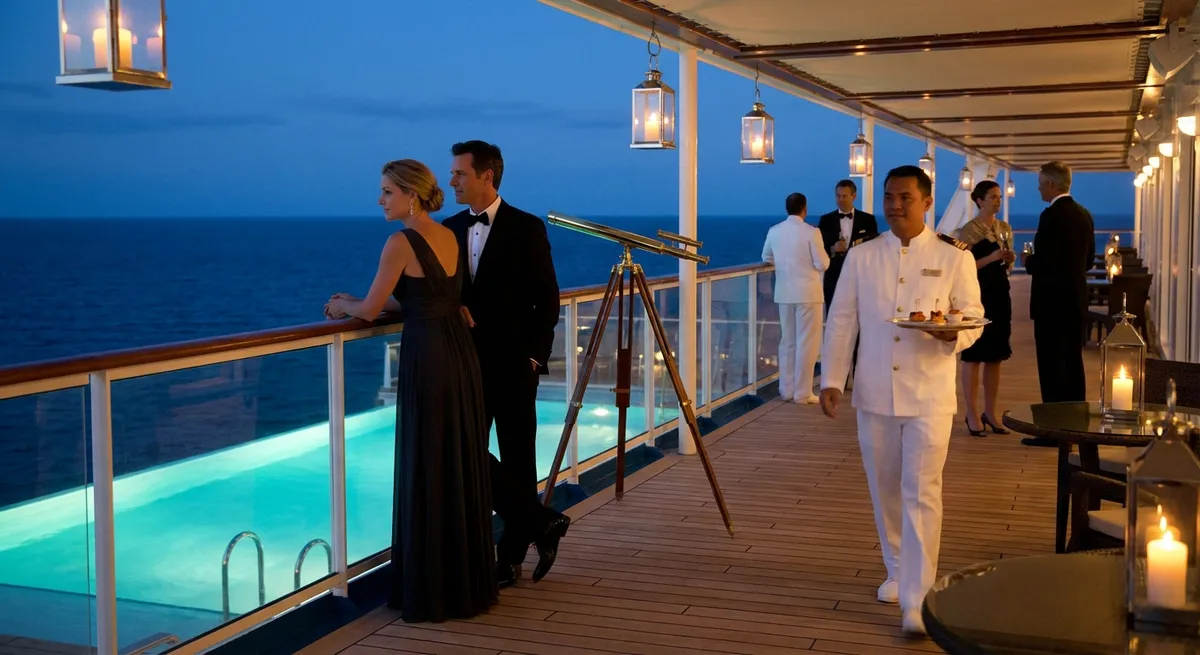
Ultra-luxury and yacht-style lines (Regent Seven Seas, Seabourn, Silversea, Ritz-Carlton Yacht Collection, Explora Journeys) favor elongated sightlines, residential design, and quiet thresholds that make public spaces feel like an extension of a private club residence. You can often identify them by the absence of visual clutter: muted signage, minimal announcements, lighting that encourages eye contact rather than stage spectacle.
Understanding this underlying “world-building” helps you choose not just an itinerary, but a way of living at sea that matches how you genuinely like to spend your time.
The Five-Minute Test: How to Decode Service Culture
The informed cruiser knows that a line’s service culture reveals itself in the first five minutes after you board, once the welcome fizz has been poured and the embarkation photo is taken.
Notice where the ship quietly invests its human capital:
- On lines with a strong European or boutique DNA, you’ll often find a higher concentration of staff in lounges and aft terraces during embarkation, guiding guests to sit, exhale, and begin with a drink rather than a transaction.
- On larger, family-focused brands, staff are strategically placed to direct guests immediately toward dining, kids’ clubs, and marquee attractions, emphasizing momentum and discovery over repose.
Another telling detail is how the crew handles small deviations. Can the bar staff adapt a cocktail to a specific flavor memory without reaching for a laminated menu? Does a restaurant host propose an unadvertised table configuration to accommodate a spontaneous gathering? These micro-flexibilities are consciously enabled (or constrained) by the line’s training and staffing philosophy.
Ultra-luxury lines often operate with deliberately low guest-to-crew ratios and empower staff to remember patterns—your preferred sparkling water, how you take coffee, whether you always request a second pillow at turndown. Premium contemporary brands may excel instead at speed and consistency: accurate room service, efficient bar queues at peak times, and well-orchestrated disembarkations in busy ports.
Once you know what you value—bespoke anticipation versus frictionless efficiency—you can interpret these early signals and select lines that align with your personal definition of “attentive.”
Quiet Design: How Space Planning Separates the Elite
For enthusiasts who have sailed multiple fleets, the real luxury often lies not in marble or chandeliers, but in how effortlessly you can disappear when you want to.
On thoughtfully designed ships, public spaces are layered rather than monolithic. That means large venues with intimate sub-zones: banquettes sheltered by screens, side nooks with two or three armchairs, terraces where windbreaks and partial shading create mini-environments. Lines such as Viking and Oceania have become known for this residential, layered approach, where you can always find a reading corner that feels privately yours, even on a full sailing.
Compare this with high-energy megaships, where the architecture often emphasizes vertical drama—multi-deck atriums, open “promenades,” and exposed sightlines that frame activities. For guests who enjoy watching the social theater of travel, this is a feature, not a flaw: you are constantly connected to the life of the ship, and the design invites serendipitous encounters.
A refined detail that enthusiasts notice is acoustics. On premium and ultra-luxury ships, materials and ceiling treatments are chosen as much for sound control as aesthetics. Take a moment in the main lounge: are you aware of clinking glassware, or is the soundscape unusually soft? Can live music be heard with clarity yet hold a conversation without strain? These design decisions cost money and rarely appear in advertising, but they transform how civilized an evening feels at sea.
Culinary Philosophy: Beyond “Fine Dining at Sea”
Today, almost every cruise line claims exceptional cuisine, but experienced travelers know to look past the number of specialty restaurants and focus on culinary philosophy—how a line thinks about food as part of the journey.
A few markers differentiate those that are serious about gastronomy:
Ingredient integrity across all venues
It is not difficult for a cruise line to offer a single showpiece venue with exquisite plates. The real indicator is the quality of bread and pastries at breakfast, the freshness of salad greens at the buffet, and the consistency of simple grilled fish. Enthusiasts pay attention to these everyday details: if the croissant crumb, espresso, and fruit quality are impeccable, it usually signals disciplined standards ship-wide.
Regionally intelligent menus
On lines with a strong culinary ethos—such as Oceania or some smaller, expedition-oriented brands—you’ll notice menus shifting in response to local markets and coastal influences. In the Mediterranean, herbs, olive oils, and seafood preparations often change subtly day by day; in Alaska, salmon and crab may appear in multiple, thoughtfully differentiated guises. When a menu feels static regardless of whether you are in Reykjavik or Santorini, the food is an amenity, not a narrative.
Human-scale dining rhythms
Truly premium lines allow you to dine when you are hungry, without excessive reservation gymnastics. Open seating, flexible dress codes that are precise yet not oppressive, and the ability to secure a quiet table for two or a convivial table for eight on short notice—all speak to an understanding that cuisine is also choreography.
For many seasoned cruisers, the dining program becomes the decisive factor when comparing lines that are otherwise similar in décor and itineraries. Thinking in terms of philosophy—how a brand uses food to express place, season, and hospitality—offers a richer lens than simply counting venues.
The Unscripted Shore: How Lines Reveal Their True Priorities Ashore
Shore experiences are where a cruise line’s philosophy faces its most complex test: logistics, local partnerships, guest safety, and cultural sensitivity must coexist. Enthusiasts quickly discern patterns here.
On large, mainstream lines, shore excursions are often designed for scale and predictability: city highlights, panoramic drives, and popular attractions in half- or full-day packages. The strength is reliability and accessibility—ideal for multi-generational groups or first-time visitors. Yet, this model can feel generic to well-traveled guests.
Premium and ultra-luxury lines differentiate themselves ashore through several strategies:
- Small-batch experiences: Limited-size excursions to private estates, after-hours museum visits, or local culinary workshops curated with specific artisans rather than large DMCs. These are rarely cheap, but their scarcity (and depth) is the point.
- Flexible independents: A shore concierge or destination specialist on board who can help you craft a customized day with vetted drivers, guides, or even self-guided walking routes tailored to your interests.
- Narrative continuity: When the stories told on board—through lectures, tastings, or enrichment programs—connect meaningfully with what you experience in port, the cruise begins to feel like a continuous, layered journey rather than a sequence of isolated stops.
A nuanced indicator is how the line handles weather or crowd disruptions. Does it simply cancel and refund, or does it have an alternate "Plan B" that still honors the spirit of the itinerary? The answer reveals whether the company views shore time as a commodity or a craft.
Five Exclusive Insights Seasoned Cruisers Quietly Share
Within enthusiast circles, a few understated truths about cruise lines surface again and again—rarely mentioned in marketing, but invaluable when choosing your next sailing:
Signature scents and soundtracks are not accidental
Many premium and luxury lines now curate custom fragrance profiles and musical scores for specific zones on board. These are designed to cue mood and memory. If you find yourself particularly attached to a lounge or corridor without knowing why, you are likely experiencing a deliberate sensory design strategy that differentiates that brand’s onboard “aura” from its competitors.
Laundry and pressing reveal seriousness about long-haul comfort
For those who take extended voyages—grand crossings, world segments, back-to-backs—the quality, pricing, and return time of laundry and pressing services matter enormously. Ultra-luxury lines often include or heavily subsidize these services, acknowledging that elegant living requires wardrobe ease. Even on premium ships, a well-run laundry operation (thoughtfully placed self-service facilities, discreet pickup and return) is a quietly luxurious asset.
The library still speaks volumes about a brand’s soul
At a time when many ships reduce physical books in favor of digital entertainment, lines that maintain a serious library—curated selections, regularly refreshed titles, and comfortable adjacent seating—signal a commitment to contemplative travelers. The depth and diversity of the collection (regional history, art, architecture, contemporary fiction, serious non-fiction) is a surprisingly accurate mirror of how the brand imagines its ideal guest.
Crew retention is a hidden luxury feature
Frequent cruisers notice when the same maître d’, sommelier, or butler reappears on subsequent voyages—and remembers them. High crew retention typically indicates a healthy internal culture, which directly translates into more confident, intuitive service. While exact figures aren’t always public, repeat sightings of familiar crew on the same line—or even the same ship—are often cited by enthusiasts as a key reason for brand loyalty.
Transition days reveal operational excellence
The day you disembark—and others embark—is when a cruise line’s operational backbone is most exposed. If public spaces remain composed, staff unflustered, and luggage handling feels almost invisible, you’re witnessing a highly disciplined operation. Some premium and ultra-luxury lines excel at maintaining a sense of calm continuity even on turnaround days, reinforcing the illusion that the ship is less a transport hub and more a private, floating residence with a constant, graceful rhythm.
Choosing the Line That Matches Your Inner Traveler
For the sophisticated cruiser, selecting a cruise line is no longer only about cabin size, brand prestige, or itinerary. It is about aligning with a particular way of moving through the world—how you prefer to inhabit shared spaces, dine, explore, and be looked after.
Once you begin evaluating lines through the lens of service culture, spatial design, culinary philosophy, and the character of their shore experiences, patterns emerge. You will notice which brands accept the mass-market logic of scale and which insist on human-scale refinement; which favor spectacle and which cultivate contemplation.
The reward for this deeper reading is profound: your ship becomes more than a hotel between ports. It becomes a carefully chosen environment that amplifies the way you already like to live—only with a horizon that changes every morning.
Sources
- Cruise Lines International Association (CLIA) – 2024 State of the Cruise Industry - Industry-wide data on growth, guest preferences, and evolving trends across cruise segments
- U.S. Federal Maritime Commission – Passenger Vessel Operator Information - Regulatory and consumer protection information for major cruise operators
- Cunard Line – Queen Mary 2 Experience - Example of heritage-focused design, dining, and service positioning in the premium/luxury segment
- Regent Seven Seas Cruises – All-Inclusive Experience - Insight into how an ultra-luxury line frames inclusions, service ratios, and onboard lifestyle
- Viking Ocean Cruises – Onboard Experience - Illustrates residential-style design, enrichment focus, and quiet luxury positioning in the premium space
Key Takeaway
The most important thing to remember from this article is that this information can change how you think about Cruise Lines.